 BORETS
In this guide
The useful answer is not a birthday. A child may be old enough for a club’s advertised age range and still need a different class format. Another may enjoy an introductory movement group without being ready for competitive grappling. For a first BJJ class, match the child’s current abilities and interest to the tasks actually being taught.
Use age as context, not a guarantee
The American Academy of Pediatrics says most children under six are better suited to basic movement and play than organized competition. Around six to nine, simple adapted sports tasks become more appropriate for many children. These are broad developmental guidelines, not a BJJ-specific minimum or a readiness certificate.
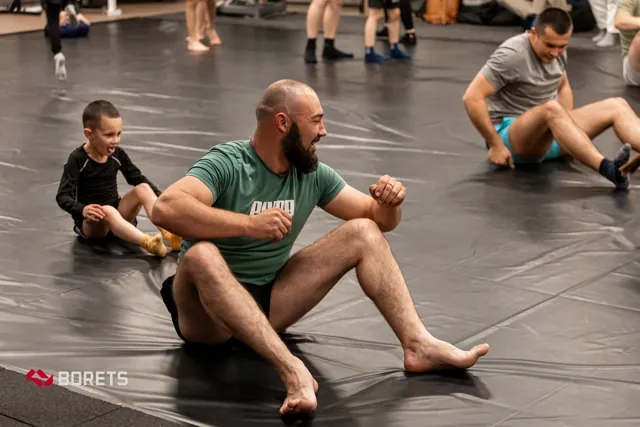
A preschool class labeled “jiu-jitsu” might mostly involve movement games and brief demonstrations. A school-age class might expect children to alternate roles with a partner. Both labels can be honest, but the demands differ. Find out whether the advertised class is introductory play, technical learning or a competition group before comparing ages.
Look for a few observable abilities
During a trial, notice whether your child can copy one short task, pause when the activity stops and let another child take a turn. They do not need perfect concentration. What matters is whether the instructor can bring them back to the task without constant confrontation or leaving the rest of the group unattended.
Partner work adds another demand: noticing someone else’s boundary. A child should be learning to release on a stop signal and seek help when confused. A cheerful, energetic child who keeps grabbing after the signal may need a simpler task or closer support before that particular paired activity is appropriate.
Distinguish unfamiliarity from a poor fit
Hanging back at the entrance does not necessarily mean a child is too young. They may want to watch one round, learn the instructor’s name or see where a parent will sit. A predictable first visit gives useful information that a sudden demand to join a noisy group does not.
On the other hand, repeated distress should not be treated as a discipline exercise. Name the problem: is it noise, a confusing task, uncomfortable contact or an unsuitable partner? Changing one condition can reveal whether the class can work. The child should not have to accept frightening contact to earn permission to belong.
Starting later is still starting
An older beginner may understand instructions quickly while needing time to become comfortable on the floor. That is a normal teaching problem, not a reason to place them immediately with experienced competitors. Look for a beginner route that respects their age without assuming their body already knows the sport.
Avoid buying urgency from comparisons with a child who already has a belt. The useful first target is participation in a manageable task, followed by a recognizable improvement. There is no need to promise a promotion date, a tournament result or a catch-up timetable to justify beginning now.
Choose the next small step
After the trial, compare what the child experienced with what the group expects next. Perhaps they are ready to repeat the same paired game. Perhaps a shorter introduction or movement-only group fits better. This is a placement decision, not a judgment about courage, intelligence or future athletic potential.
Ask the child which part they understood and which part needs explaining. Agree on the next visit without promising that everything will feel easy. A useful start gives the child a task they can recognize, an adult they can approach and a clear way to stop when something is wrong.