 BORETS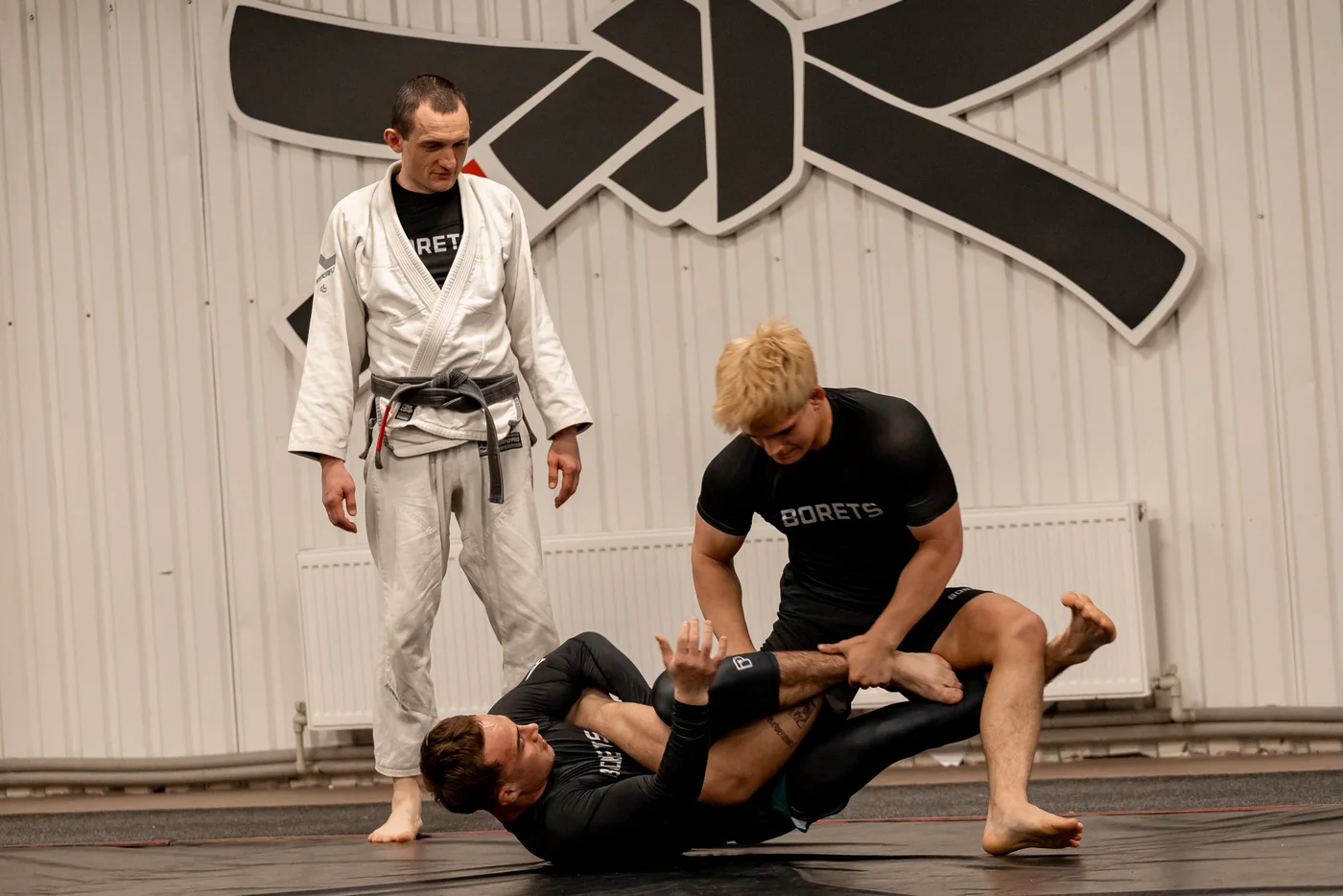
In this guide
Leg locks are submissions directed at the foot, ankle or knee through control of the leg. Straight ankle locks, kneebars, toe holds and heel hooks do not share the same mechanics or competition permissions. Learn the entanglement, escape routes and your division's rules together: a legal position in one event may be prohibited in another.
Four common leg-lock families
A straight ankle lock applies pressure to the foot and ankle. A kneebar uses control of the leg to apply extension at the knee. A toe hold uses a figure-four grip on the foot; a heel hook controls the heel while the entanglement limits rotation. Changing the grip or direction can change the attack and its legality.
Do not divide them into safe locks that hurt first and dangerous locks that do not. Any can injure. Early drills teach recognition and controlled positioning with a tap-and-release agreement, rather than a test of pain tolerance.
Positions come before finishes
Ashi garami, single-leg X, outside ashi, 50/50 and the saddle describe related but distinct leg positions. Terminology varies between schools. The practical questions are where the knees are, which leg is trapped, whether the opponent can turn or stand, and what is happening to your own legs.
The knee line describes whether a knee remains inside the controlling legs or has moved beyond them. Not every lock requires identical control, and clearing one connection does not automatically make the whole position safe. Learn each configuration before linking them.
Straight ankle lock versus kneebar
The straight ankle lock is allowed from adult white belt under IBJJF rules, subject to the permitted position and movement. The kneebar is not: brown and black belts may use it in Adult and Masters divisions. Calling both straight locks does not make both beginner-legal.
Separate entry and control from finishing. Can you establish the intended position without losing balance or allowing the opponent to turn freely? Can you recognise when they have cleared it? Let your coach set when finishing pressure and resistant rounds enter that progression.
Toe holds and heel hooks are different attacks
A toe hold uses a figure-four grip on the foot; a heel hook uses heel control and rotation against a trapped leg. Under IBJJF rules, permitted toe-hold variations are available to Adult and Masters brown and black belts in gi and no-gi. Heel hooks have the narrower Adult brown/black no-gi exception.
A familiar entanglement does not make every finish legal. Outward-pressure toe holds and particular turning directions have their own restrictions in the IBJJF chart. Establish exactly what your gym and competition allow before a leg-lock round.
Early defence
Deny the entry, hand fight, manage the free leg and work to clear the relevant leg control. The correct direction depends on the entanglement and attack. Turning a knee away is not a universal escape instruction.
Do not spin explosively against a captured heel. If you cannot identify a controlled escape from a secured submission, tap and reset. Practise directions first from agreed positions with the finishing grip inactive, so uncertainty does not become joint pressure.
The rules: IBJJF, ADCC, sambo and UWW
IBJJF: straight ankle locks are available from adult white belt. Kneebars, toe holds and biceps/calf slicers are permitted for Adult and Masters brown and black belts. Heel hooks and knee reaping are permitted only in Adult brown and black belt no-gi divisions, not Masters and not gi. Grips, turning direction and position still matter.
ADCC professional events and Open divisions have different age and experience categories. Submission-only is a format description, not a shared list of legal attacks. Check the organiser's division rules rather than assuming every adult event allows heel hooks.
FIAS sport sambo permits leg submissions but prohibits specified twisting attacks and foot knots. A leg submission stops when the defender reaches a standing position. UWW grappling uses its own age-and-skill table; its July 2026 rules restrict heel hooks to Senior and U20 Advanced. A BJJ belt colour is not a substitute for checking those categories.
Ask a precise leg-lock question
Identify the position and rules you train under. For example: 'I am an adult white belt training gi. How do I recognise when my ankle-lock entry becomes an illegal reaping position?' That gives a coach a clearer problem than a request for the fastest finish.
BORETS combines sambo, wrestling and BJJ experience. Kostiantyn Zhyvanov, who grew up in the team, finished second in the men's professional under-66 kg category at the 2026 ADCC European, Middle East and African Trials in Belgrade. The organiser's published results record that achievement as part of the team's experience across rulesets.
Register for the BORETS LAB launch to join our team wherever you train. Membership will let you choose Ievgen Skyrda, Oleksandr Oliinyk, Kostiantyn Zhyvanov, Yaroslav Blazhko for children's development, or Mykola Chaban for freestyle wrestling. Send a specific question and receive a private written answer in your account; when useful, the team can record a video addressing it.