 BORETS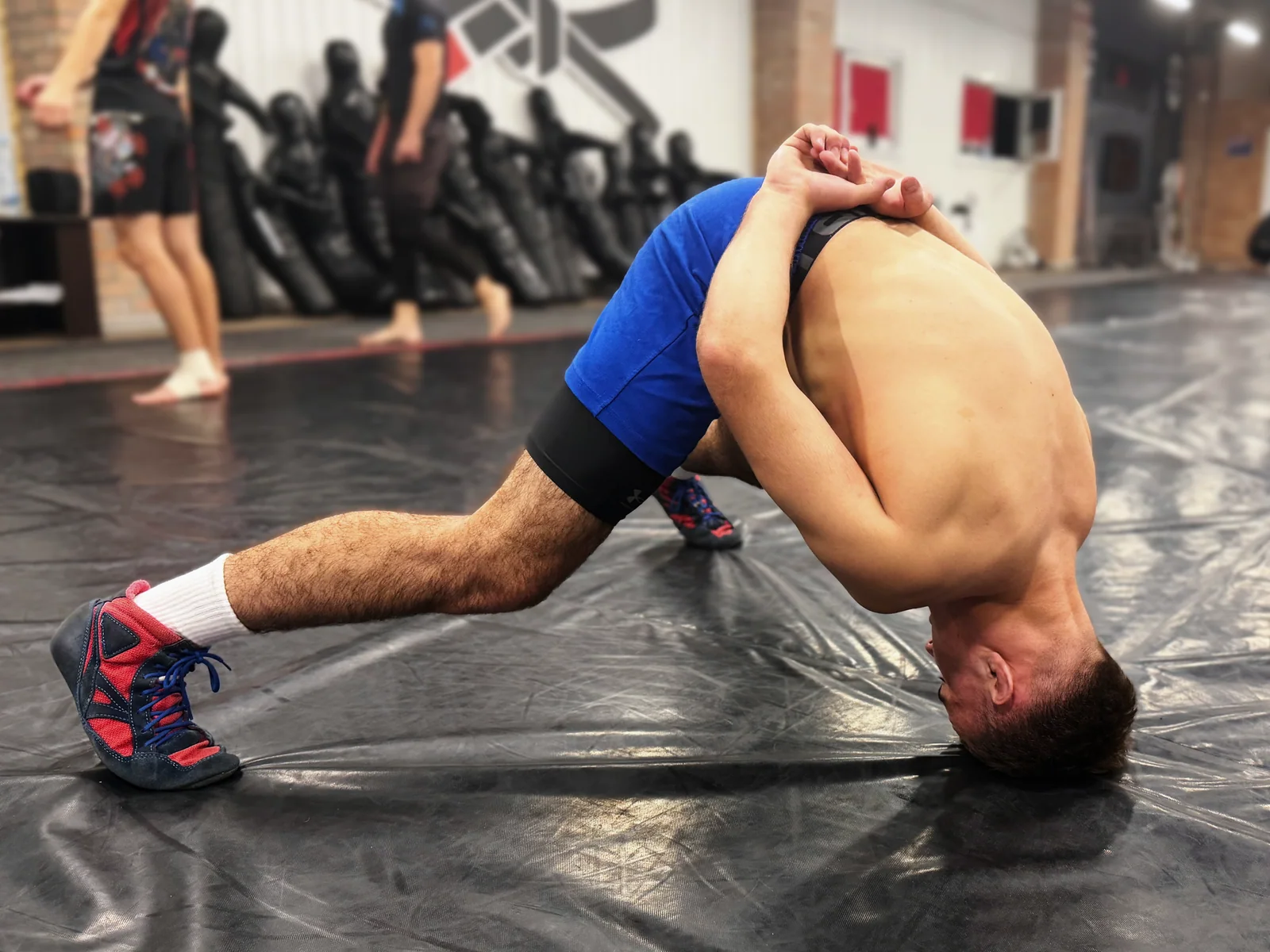
In this guide
Neck training should be a controlled strength task, not a test of how much pressure someone can endure. Wrestling involves changing head positions and contact, but the first conditioning exercise can be much simpler: maintain a comfortable neutral position against gentle, predictable resistance. This article describes familiarisation for healthy, symptom-free adults, not rehabilitation after a neck injury. Current pain, recent injury or neurological symptoms require an appropriate clinical assessment before loading. A stronger neck also does not make an unsafe wrestling position acceptable.
Find neutral without becoming rigid
Sit upright with feet supported, ribs over the pelvis and eyes looking ahead. Avoid pushing the chin forward or pulling it hard towards the chest. Place a palm against the forehead and gently press the head into the hand while the hand prevents visible movement. Build pressure gradually, then let it fade before removing contact. The shoulders should not rise to the ears. Practise a few easy breaths during the hold; breath-holding and a clenched jaw often reveal that the effort is already too high for this stage.
Practise directions separately
Repeat the same principle with the palm at the side of the head: resist a small sideways pressure without tilting. Work both sides. For a backward effort, use a comfortably positioned hand behind the head, keeping the chin level; skip that variation if the arm position makes you compensate. Do not combine rotation and strong pressure while learning. Self-resistance gives the athlete direct control over the force. A partner should not suddenly push harder or turn the exercise into a contest.
A familiarisation dose, not a maximal test
One conservative practice example is two holds of five seconds in each comfortable direction, with about 15–20 seconds of complete relaxation between holds. Keep effort light, approximately three out of ten, and finish feeling capable of repeating the sequence. That is practice in controlling tension, not a proven optimal strength prescription. Begin on a day without heavy head-contact work. Stop immediately for pain, dizziness, tingling, headache or loss of position. Do not treat those responses as normal training discomfort to overcome.
Progress resistance without losing the position
After several comfortable sessions, change only one feature: slightly more pressure or a slightly longer hold. Keep the same breathing and head position. A qualified strength coach can then select measurable resistance and an appropriate weekly dose. Log the direction, hold time, perceived effort and response later that day. If you need to lean the torso or brace the hand against furniture to win the hold, the exercise has changed. Return to a version you can control instead of counting a forced repetition.
How to fit neck training into a BJJ week
BJJ already loads the neck through hand fighting, positional pressure and accidental poor alignment. Count those sessions when adding separate neck work. For an adult using the light familiarization holds above, begin with one short session on a day without demanding head-contact practice. If it is comfortable during and afterward, a second nonconsecutive slot can be considered before increasing resistance.
For example, with hard rolling on Wednesday and Saturday, use a brief light practice on Monday and, if recovered, Thursday. Keep Thursday’s technical session free of extra heavy head-pressure drills. If that arrangement leaves the neck tired for Saturday, remove the second slot. The calendar is an example of distributing load, not a validated BJJ injury-prevention protocol.
A stronger neck does not replace escaping or tapping
Separate exercise from the technical problem. If a partner repeatedly controls your head from side control, inspect your frames and positioning. If you are being stacked, work on the guard decision that allowed your hips to travel over your shoulders. Adding more neck resistance is not the first answer to either situation.
Never use a choke, neck crank or a partner’s stacking pressure as a strength test. The self-resisted exercises here do not establish that you can safely resist a submission for longer, and improved neck strength is not proof of concussion protection. Keep the light holds a small supporting task while your coach addresses the position that created the load.
Know what the evidence does and does not show
A supervised rugby trial found improved neck strength after self-resisted training, while another trial in elite women’s football-code athletes did not find the same improvement. Those populations and protocols are not interchangeable with beginner wrestlers. They do not justify a promise of concussion prevention. Neck bridges, external harness loads and rapid partner resistance require separate preparation; they are not automatic upgrades from these holds. Children need an individual, supervised approach. The practical target here is reproducible control across sessions, leaving enough capacity for technical training.