 BORETS
In this guide
The rear naked choke is a submission from behind an opponent that does not require clothing grips, also commonly called the RNC or mata-leão. Its name does not mean it belongs only in no-gi competition. For training, the essential starting point is back control: stay connected while the defender turns, moves their shoulders and contests your hands.
Connect the chest, shoulder line and hips
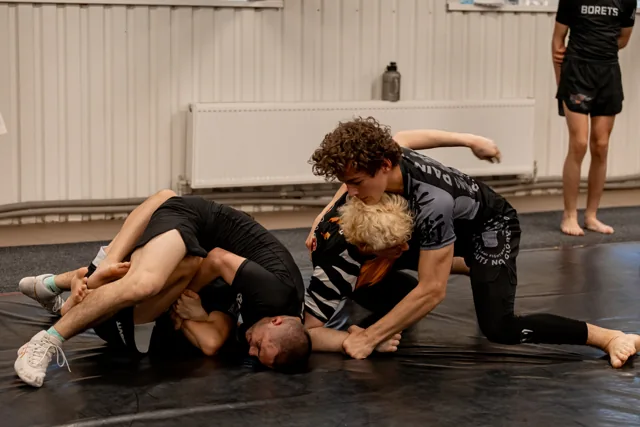
A seatbelt-style hold places one arm over the shoulder and the other under the opposite armpit. Keep your chest close to the defender’s back and your head beside theirs rather than hanging away behind them. The lower-body control, often hooks inside the thighs, helps you follow the hips when the defender moves.
These contacts have different jobs. The upper connection follows the shoulder line; the lower connection limits how freely the hips separate. If the defender places their shoulders on the mat while your legs remain attached, the hooks alone have not preserved back control. Adjust with the torso instead of stretching the arms to keep a distant grip. The attack becomes easier to organize when the back position stays compact.
Create access through the hand fight
The defender will often use two hands against the wrist of your attacking arm. Trying to pull that arm straight backward turns the exchange into a grip contest and may open your chest connection. Keep the elbow close enough to remain connected to your torso while your other hand manages one of the defending wrists.
The aim is to reduce the defender’s ability to keep both hands on the same wrist at the moment your attacking hand advances. Change one useful contact at a time. If both hands abandon control together, the defender can turn their shoulders before the grip is rebuilt. Work around the whole hand or wrist, without peeling individual fingers.
Organize the attacking arm and supporting hand
In the common figure-four version, the attacking arm surrounds the neck with its elbow oriented beneath the chin. That alignment brings the upper arm and forearm around opposite sides rather than leaving the forearm misplaced across the jaw. The attacking hand connects to the opposite biceps; the supporting hand settles behind the head to complete the structure.
Keep the supporting elbow compact and your own head close. Large gaps give the defender room to turn or reach inside the grip. The hands organize the connection; the arms and torso act together instead of performing a large backward pull. If the chin blocks access, continue the positional and hand-fighting work rather than treating jaw pressure as the same technique.
Read the first part of the escape
When the defender controls your wrist but their shoulders remain against your chest, the hand fight is the immediate problem. When a shoulder separates and approaches the mat, restoring back control becomes the more urgent task. Continuing the same neck entry through both situations ignores a change in the position.
Follow the shoulder line with your chest and use the lower-body connection to stay near the hips. If the defender has already turned to face you, recognize that the back position has ended. A deliberate transition to another control is preferable to keeping a stretched grip on a body that now faces a different direction.
Test retention, access and alignment separately
Run one short round focused on keeping chest-to-back contact, then another on freeing a controlled wrist without losing that contact. Add the finishing configuration only after you can connect those two tasks. Film the whole upper body if both partners agree; a hand close-up hides the shoulder movement that often decides the exchange.
Use direct supervision for finishing practice, increase pressure gradually and release immediately at any tap or stop signal. Never test tolerance to a choke. Check the current IBJJF restrictions for the exact division and variation. Record the first failure—shoulder connection, hand access or arm alignment—so the next repetition has a specific correction.