 BORETS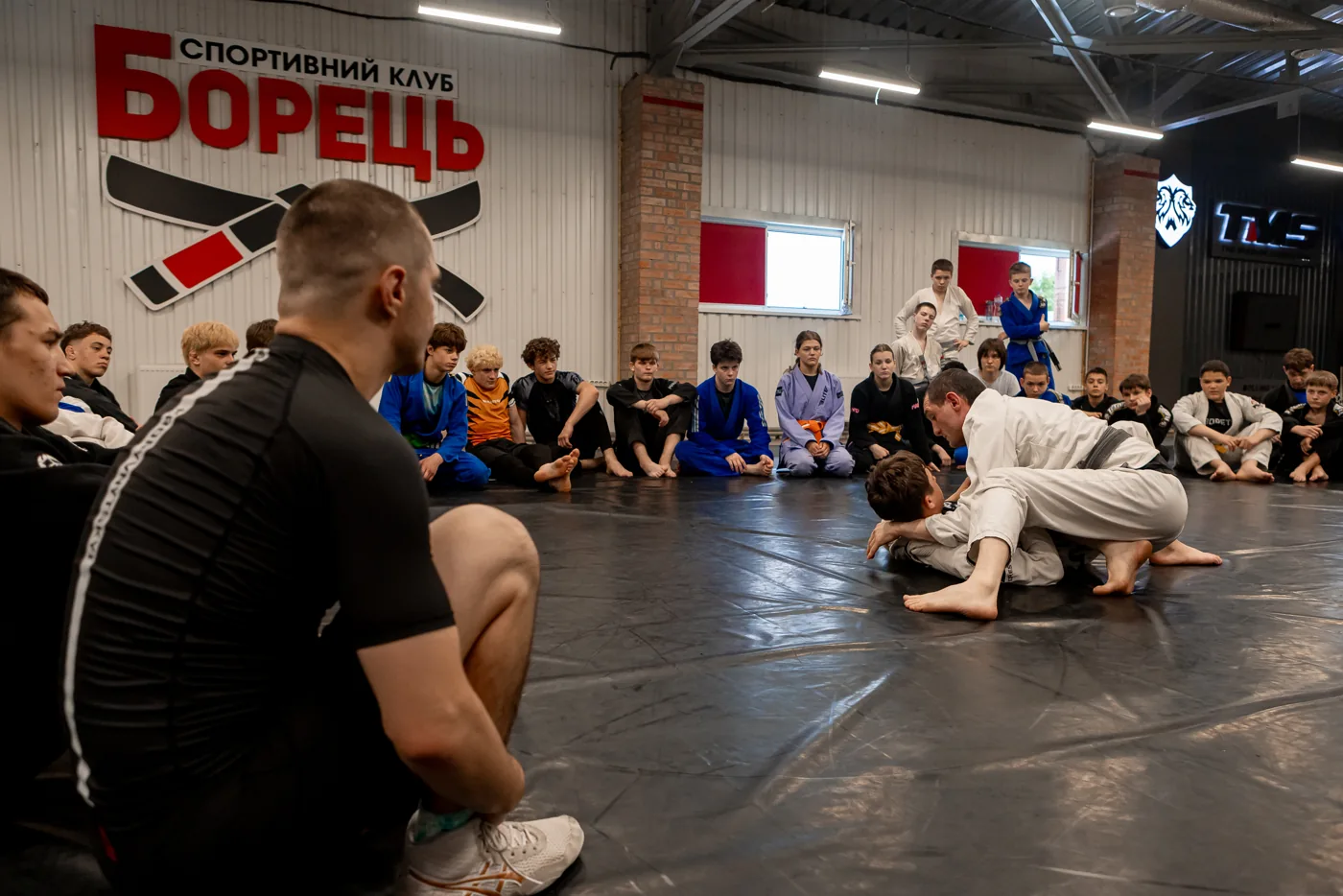
In this guide
Online BJJ lessons work best when you connect them to coached practice with a partner. Choose one problem, watch an explanation, test it on the mat and review what happened. This guide gives you that loop, a sample training journal and a way to choose resources that fit your current questions.
The loop: watch, test, review
Watch means one technique, one sitting, with a question in mind: what are the three details that make this work? Write them down in plain words before you close the video. If you cannot name three, watch again; if you can, you are done watching for now.
Test means taking those details to the mat, with a cooperative partner first and then a resisting one, inside a constrained round: start in the position, try only that technique, note what happens. Ten minutes of testing teaches more than an hour of re-watching, because it tells you which detail you actually lost. Review means one line after training: what happened, what changes next time. Only then re-watch the part of the video that addresses the problem you found. Reversing the order, watching until it feels understood, is how people come to feel they know jiu-jitsu they cannot do.
How to watch a lesson so it sticks
Watch once at normal speed with no notes, to get the shape. Watch again and pause every time the instructor shifts weight or changes a grip; those are the details. Say them out loud: my left hand goes to the far collar before my hips move; the elbow stays inside the knee. Language you can repeat is language you can drill.
Watch the instructor's hips and the partner's reaction, not the finish. Most of what makes a technique work happens a second before the part the camera zooms in on. And limit yourself: one technique or one short sequence per week is a realistic load for someone training two or three times. More than that and the mat time to test it does not exist, and untested techniques evaporate within days.
Solo work versus partner work
Solo drills are for movement, not technique. Practise movements your coach has already taught, such as shrimping and technical stand-ups, on a suitable clear training surface. More demanding rolling movements need instruction and appropriate matting. Ten minutes a day is a real investment.
Technique is a conversation with another body. You cannot learn timing, pressure or the feeling of a partner's weight from a dummy or the air. A dummy lets you rehearse the sequence of hand placements; it cannot tell you your hips were in the wrong place, because it will never resist. Solo for movement every day, partner for technique every session you can get, and never let the ease of solo work persuade you that skill is building without a partner.
Remembering techniques: three cues and a journal
Memory in jiu-jitsu works by attaching a new technique to a position you know and a problem you have. So remember three cues, tied to a position, tied to a problem. Position: bottom of side control. Problem: weight on my chest. Cues: elbow in, frame on hip, bridge before shrimp. That is a memory you can retrieve under pressure.
A journal turns it into a system, one short entry per session. Here is a sample journal week. Monday: watched closed guard hip-bump sweep; cues: sit up on the elbow, post the hand behind, bump to the same side as the post. Tuesday: tested; cooperative partner fine; resisting partner posted his hand and I could not finish; review: I bumped straight up instead of across; re-watch the angle section. Thursday: sweep worked twice in five once I bumped across; next: combine with the kimura when he posts. Those notes connect your viewing to an observable result and a question for the next session. Read the entries back once a month; the patterns in your problems are your curriculum.
Choosing an instructional worth your time
Choose by problem, not by fame. The best leg lock instructional in the world is worthless to a white belt being smashed in side control. Write down your three most common problems from the journal and watch only material that addresses one of them.
Then judge the teaching, not the credentials. A good instructor shows the technique against a partner who reacts realistically, explains what happens when the partner defends, and does not pretend the technique always works; be suspicious of anything with no failure cases. Finally, prefer sources that let you ask. A video you can question is worth several you cannot, because feedback is the piece video cannot give by itself.
Beginner books and YouTube channels: a useful starting shelf
Stephan Kesting’s free Roadmap for Brazilian Jiu-Jitsu from Grapplearts is a practical first reading choice: it organises the major positions so unfamiliar names have a place. Use it beside your class notes, not as a list of techniques to attempt without instruction.
For video, Grapplearts offers explanations and beginner resources; the BORETS YouTube channel lets you see our athletes connect sambo, wrestling and jiu-jitsu. Compare how an instructor explains the position, the partner’s response and a common failure. The best beginner channel for you is one that helps solve a problem you can actually practise this week, rather than the channel with the longest playlist.
The honest limits of video
Video cannot feel your weight. It cannot tell you your frame collapsed because your elbow drifted an inch, cannot pace your progression and cannot stop you from drilling a mistake into your body for a month. Nor can it tell you what to work on next; it answers the question you asked, and beginners often ask the wrong question. A coach watches you roll and tells you the real problem is your posture, not the sweep you came to ask about.
What video does well is give you a language, a set of cues, a picture of what the position should look like and a wider view of the sport than one room can provide. Used inside the loop, that is a real advantage. Used instead of the loop, it is entertainment. Nothing online replaces a partner on the mat, and we will never tell you otherwise.
Where BORETS fits
Our school has taught sambo, jiu-jitsu and wrestling together in Kropyvnytskyi for years; our founder, Ievgen Skyrda, came to BJJ after fifteen years of judo and sambo and earned his black belt under Max Carvalho. The BORETS YouTube channel already shows what that connected system looks like in a real room. We are building an online school around the same loop, and membership is designed to close the gap this guide keeps pointing at: consultations with Ievgen Skyrda, Oleksandr Oliinyk, Kostiantyn Zhyvanov, Yaroslav Blazhko and Mykola Chaban on your own questions, and the option to request a video breakdown of the exact situation from your journal. The video school is still being prepared, so registering now is the first step. Bring the notebook.