 BORETS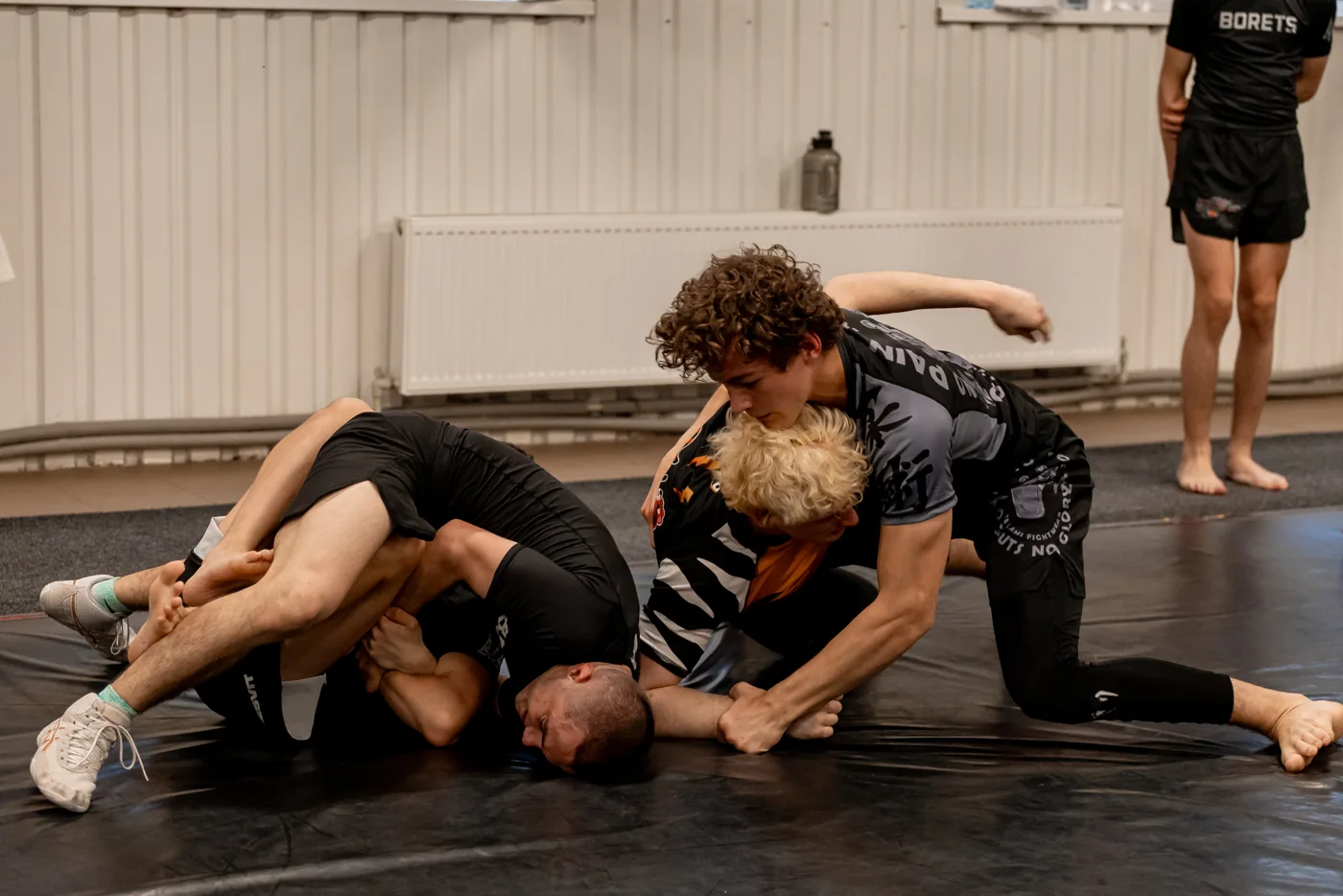
In this guide
A position name should help you make the next decision. “Side control” tells you where the bodies are; it does not tell you who controls the hips or whether an escape has already started. Learn the main BJJ positions as a map of competing jobs: what the top athlete needs to keep, what the bottom athlete needs to recover, and what changes when either succeeds.
Standing: the map starts before the ground
Standing is a position too. Before a takedown, both athletes are managing distance, balance and grips. A grip that feels strong can still leave your feet poorly placed. Ask what the connection actually prevents: a step, a turn, a level change, or nothing yet.
For a beginner, the useful connection is standing to a controlled landing and a recognisable ground position. Practise that transition with a coach before adding resistance. Landing on top is only the beginning if the other athlete immediately puts their legs between you.
Guard: the legs keep a contest alive
Guard describes a family of positions where the bottom athlete uses the legs to manage the opponent. Closed guard wraps both legs around the torso. Open guard uses changing contacts. Half guard retains one of the top athlete’s legs. These labels describe connections, not guaranteed safety or attacking success.
From below, the immediate job may be maintaining distance, breaking balance or coming up. From above, it may be clearing those connections without losing balance. Example: if a passer gets beyond your feet but one knee still separates your bodies, the pass is not necessarily complete.
Side control and mount: holding while someone escapes
In side control, the top athlete has passed the legs and controls across the torso. In mount, the top athlete straddles the torso. Both can offer strong attacking opportunities, but neither works simply because the athlete above is heavy. Connections must survive the opponent turning, framing and moving their hips.
For the bottom athlete, a useful first goal is recovering enough space to bring a knee or another frame back into the exchange. A frame is a supporting structure, often made with a forearm or shin. It manages space; it is not a promise that pushing harder will solve the position.
Back control and turtle: facing matters
Back control places an athlete behind the opponent with upper-body and lower-body connections. The defender cannot address every connection at once, so recognising the immediate submission threat matters. Having someone behind you and conceding a formally scored back-control position are not always the same thing.
Turtle is a compact knees-and-hands or knees-and-elbows position. It may appear during a scramble or an escape from a pin. It can protect access to the front of the body while exposing the back. Treat it as a position requiring a next action, rather than a place to wait indefinitely.
A position is not a score
Competition rules decide which transitions score and what counts as stable control. Do not assume that every reversal is a sweep or that briefly reaching a position earns points. Check the rules of your event; the IBJJF rule book is a reference for IBJJF competition, not every grappling format.
For learning, separate three questions: where are we, what can each person do, and what would the referee award? That prevents a beginner from confusing a useful defensive improvement with a scoring action.
A simple test for your next session
Choose one position with your coach. Give each partner one clear objective and a reset condition: for example, retain guard versus pass and establish control. Begin with manageable resistance and switch roles. After each reset, name the connection that changed.
Keep the note concrete: “My knee stopped separating our bodies” is more useful than “My guard is bad.” That is how a position dictionary becomes a method you can test.
During video review, pause before a transition. Name the connection being lost, then predict the next position before watching the outcome. Compare your prediction with what actually happens.