 BORETS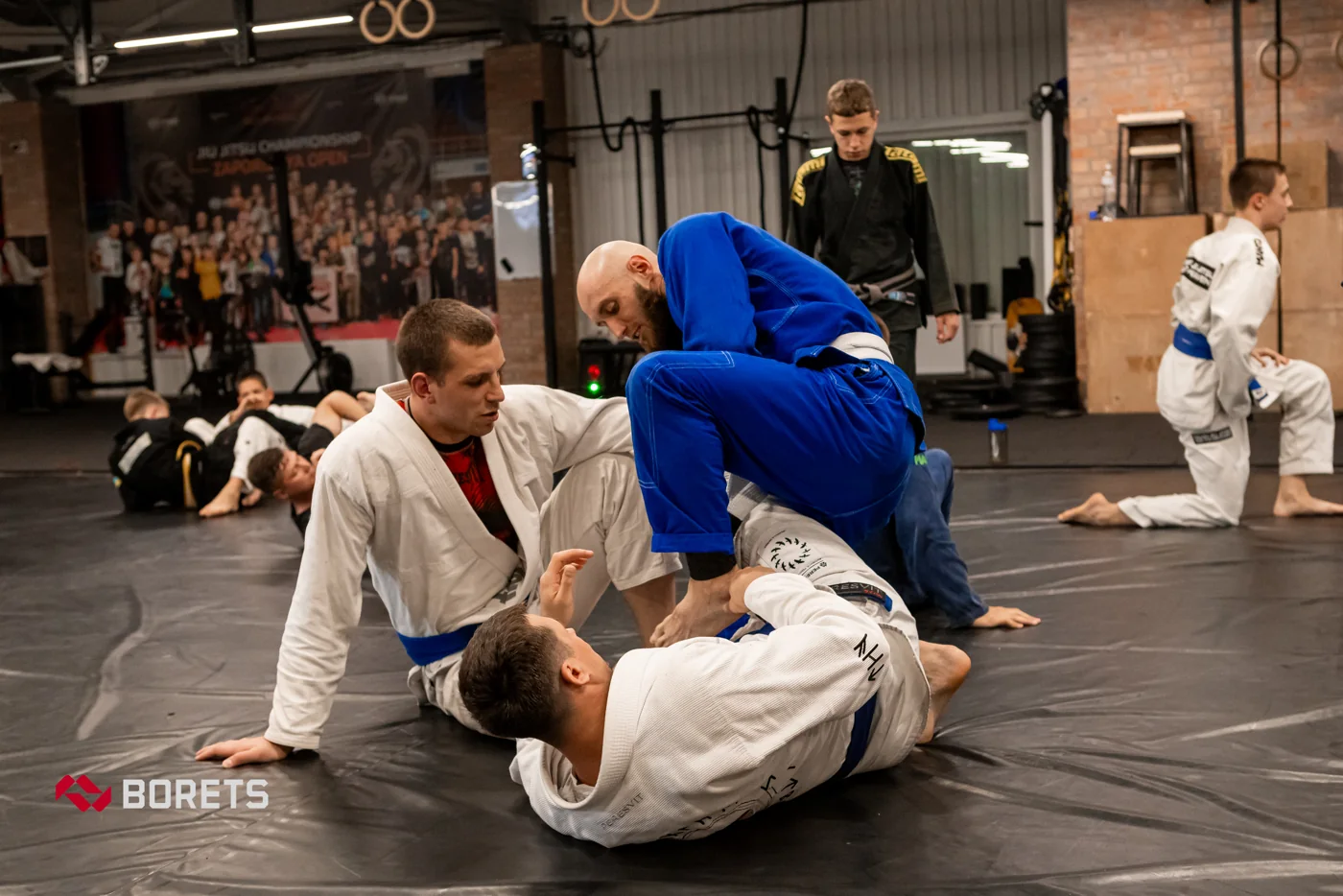
In this guide
Guard passing means getting beyond an opponent's controlling legs and establishing a stable top position. Beginners often rush around the legs and miss the controls that make it possible. Work through balance, grips, leg positioning and the final pin. A pass is not complete simply because your knee or chest has reached the other side.
Opening closed guard: balance before movement
Manage the opponent's grips and establish a base before opening. Standing and kneeling openings both have useful variations; neither is automatically safest for every beginner. A coach should show where the hands, knees and feet belong in the version you practise.
Standing increases the demands on balance and grip control. Kneeling needs a coordinated change in base and hip position. Digging an elbow painfully into the thigh is not a substitute for structure. Keep control through the opening so the bottom player does not immediately take the next grip or angle.
Passing routes: around, through and under
A toreando or bullfighter pass works around the legs by controlling and redirecting them. A knee cut moves through the space between the legs and across a thigh. Double-under passing works beneath both legs; over-under combines control over one leg and under the other. A leg drag redirects a leg across the opponent's body.
These are organising ideas rather than rigid categories. Learn one route and one response when it is blocked. In pressure or stacking variations, learn the positioning instead of driving the partner's weight onto their neck.
Posture, grips, leg control, pass, stabilise
Balance depends on the pass: standing outside the feet differs from settling into half guard. Establish the connections your route needs, manage the knees and hips, then advance without abandoning those controls too early.
After clearing the legs, address the frames that could bring them back. Under IBJJF rules, passing scores three points after the required three seconds of stabilised side-control or north-south control. Clearing one knee or arriving briefly chest-to-chest does not establish all scoring requirements.
Pressure and movement work together
Pressure passing uses position and weight to reduce movement. Movement-based passing changes angles before the guard reconnects. Both require balance and timing; body size does not assign you one compulsory style.
Try maintaining your first passing route while it remains open, then change when the partner commits their frames or legs to blocking it. Preserve a useful connection through the change. Running around the feet without controlling anything can create movement without progress.
When half guard becomes a lockdown
The lockdown is a half-guard leg configuration that can restrict and extend the trapped leg. Do not rotate forcefully while that leg remains fixed. Identify the controlling feet, recover a stable position and practise the disengagement your coach teaches.
There are several releases, depending on the leg and upper-body connections. A blind backstep is not a universal answer. Practise at low resistance and reset if pressure loads the knee. Once the leg is free to move, reconnect with the passing sequence.
Secure the result
Manage hip movement and frames as you arrive in side control. Reaching immediately for a submission can give back the space you earned. Practise staying connected while the opponent turns or brings a knee inside.
Split practice into an opening round and a stabilisation round. Record whether you cleared the legs and whether you kept useful top control. If one part repeatedly fails, ask about that exact moment: the grip lost, frame inserted or leg still trapped.
Register for the BORETS LAB launch to join our team wherever you train. Membership will let you choose Ievgen Skyrda, Oleksandr Oliinyk, Kostiantyn Zhyvanov, Yaroslav Blazhko for children's development, or Mykola Chaban for freestyle wrestling. Send a specific question and receive a private written answer in your account; when useful, the team can record a video addressing it.