 BORETS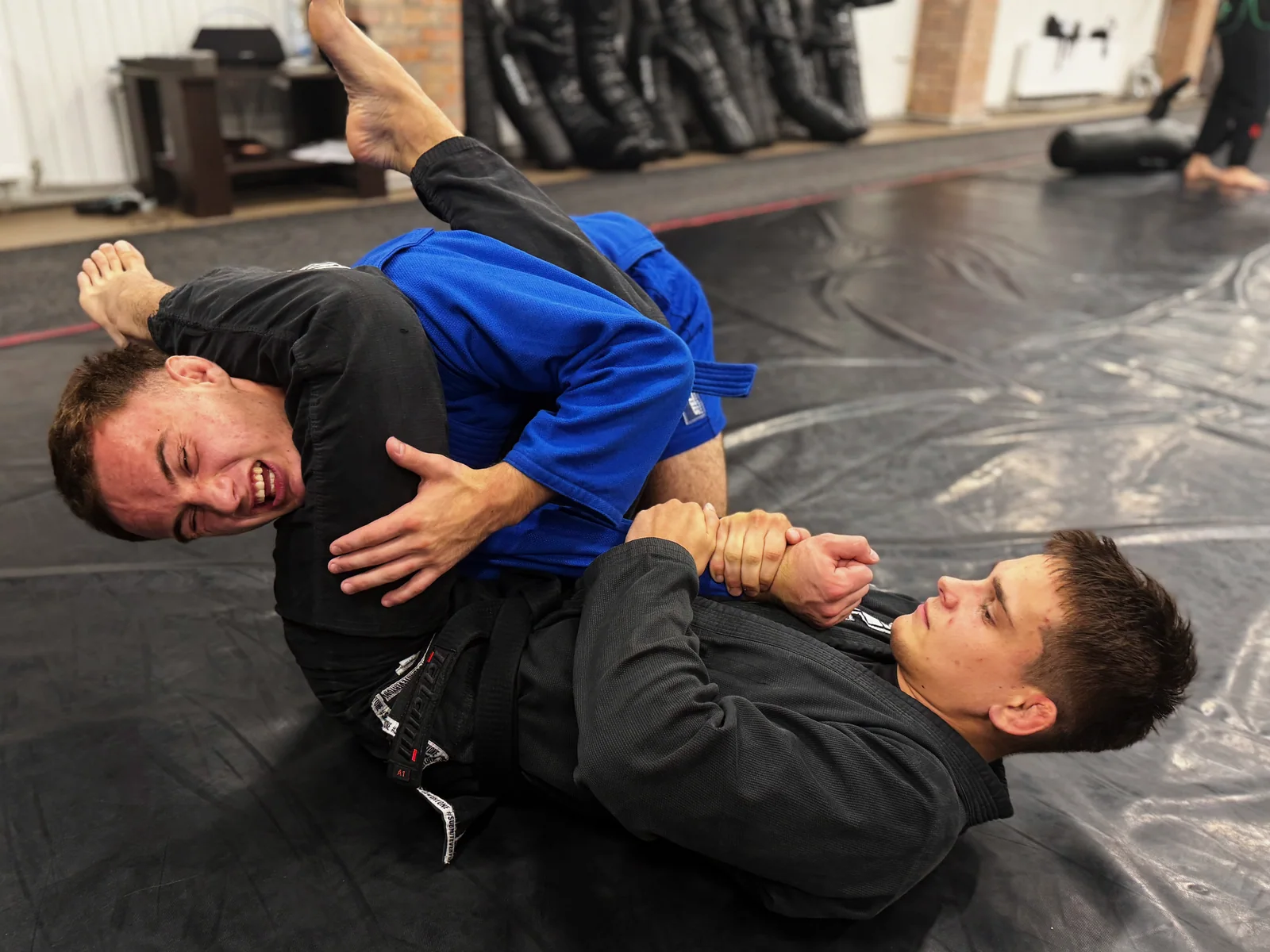
In this guide
A closed guard armbar begins with a positional problem: can you keep an opponent’s arm connected to you while changing the angle of your body? The visible leg movement comes later. Learning that connection makes it easier to understand why an attempt succeeds, why the elbow escapes and when to return to guard.
Keep the elbow inside the control before opening guard
Choose one arm to attack and connect to both its wrist and upper arm. The wrist tells you where the hand is; the upper-arm contact helps prevent the elbow from retreating to the opponent’s ribs. If you hold only the hand, the opponent can often bend and withdraw the elbow while you still appear to have a grip.
Bring the selected arm across your center enough to make the shoulder follow. Keep the opponent close with your legs while arranging the grip. Opening your ankles before establishing this connection gives them room to sit upright and recover the arm. The order matters: control the arm and posture, create an angle, then move the leg across.
Turn the hips; give each leg a job
In a common closed-guard entry, the foot on the attacked-arm side posts on the opponent’s hip. That support helps you turn your hips toward a more perpendicular angle instead of trying to swing the head-side leg over from a square position. Keep the wrist and upper arm connected during the turn.
The opposite leg stays high across the back to manage the shoulder line. The head-side leg then passes over the head and settles with controlled contact. One leg limits the opponent’s ability to rebuild posture; the other keeps their shoulder close. If both legs drift low toward the waist, the upper body can rise even though the arm still appears to be between your knees.
The elbow line explains the leverage
The armbar depends on keeping the upper arm contained while the elbow remains over the hip line used as the fulcrum. Your thighs limit side-to-side movement, and the wrist connection organizes the forearm. If the elbow slides out toward your knees and away from that support, raising the hips often just moves the opponent’s arm without maintaining the intended lever.
Keep the knees close enough to contain the upper arm and the wrist close enough that the opponent cannot freely turn the elbow. In a conventional demonstration, the thumb points upward as a useful orientation cue. It is not a substitute for checking the elbow itself. Learn the difference between a controlled catch and an arm that has already slipped free.
Make recovery part of the repetition
An armbar attempt can leave your guard open. Decide in advance what you will do when the arm is no longer available. A sensible early objective is to reconnect your legs and hands to a usable guard, keeping track of the partner’s passing direction.
Avoid turning every failed entry into a hurried submission chain. First learn to recognize a lost attack. In a constrained round, let the partner choose between protecting the arm and beginning a controlled pass. Your job is to identify that choice and either retain the catch position or recover guard. Count those decisions separately from submission outcomes.
Test the three connections
Use three checks during a controlled repetition: did the elbow stay connected while you opened guard, did the hips turn before the leg crossed, and did both legs retain the shoulder line? Let the defender withdraw the arm at a moderate pace, then identify the first connection that failed. Preserve guard when the arm is gone instead of chasing its wrist.
For supervised adult practice, catch the position before extending the arm, apply any finishing pressure gradually, tap early and release immediately. Check current IBJJF division restrictions before competition; this guide does not establish permission for youth divisions. A useful training result is a repeatable entry with a clear recovery when the elbow escapes.