 BORETS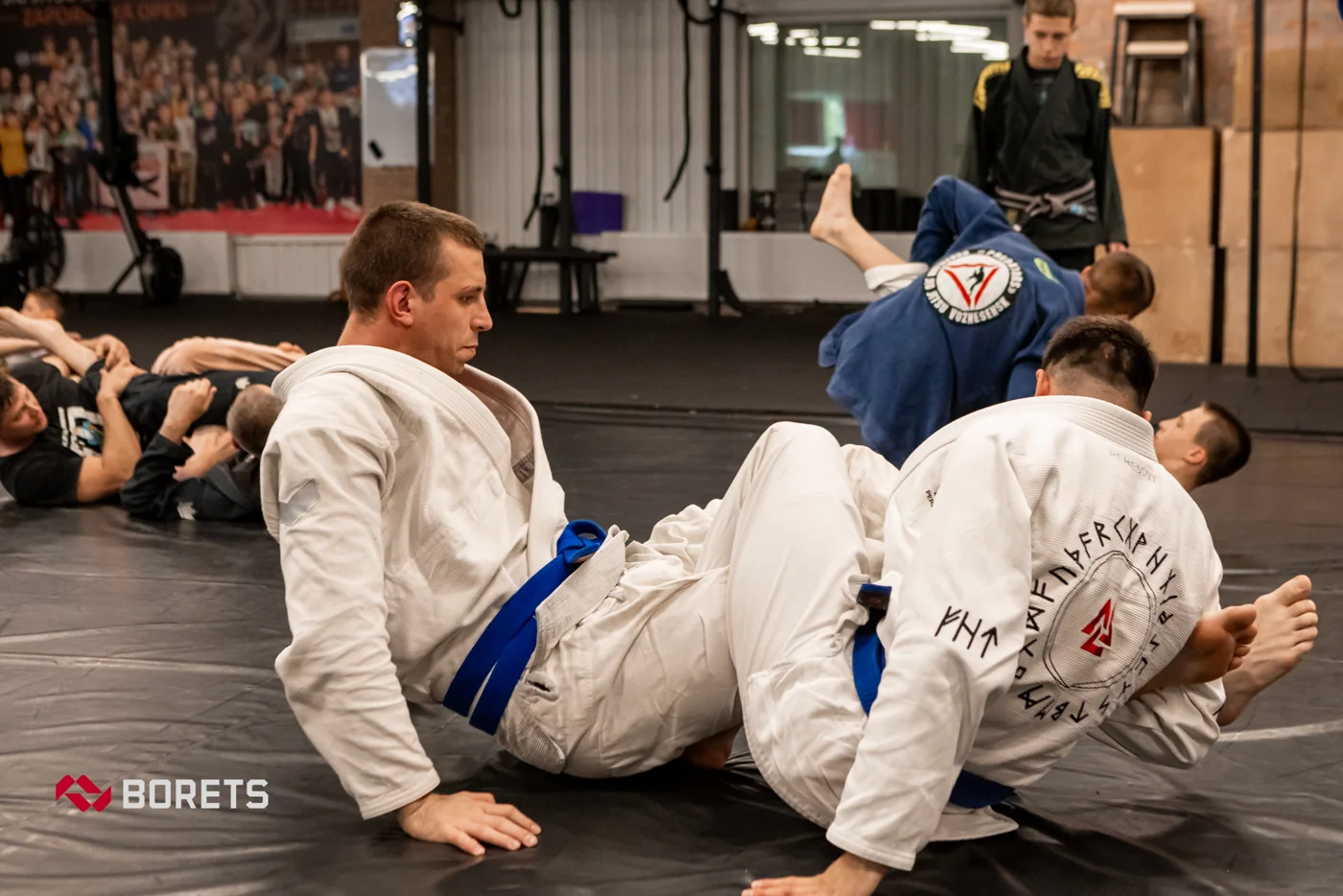
In this guide
Guard retention is the work of keeping an opponent from settling beyond your legs while preserving a position from which you can act. It includes adjusting distance, turning your hips and rebuilding contacts as the passer changes direction. Learning it as a series of observable decisions is more useful than collecting unrelated recovery movements.
Use distance to identify the current task
At longer distance, the passer may still be outside effective leg contact. Your task is to organize your position so you can connect without overreaching. At middle distance, feet, shins, knees and hands can establish barriers. At close distance, the passer may already be working around those barriers and controlling your hips or shoulders.
These are useful teaching zones, not universal measurements. Identify where the task changes in the guard you are using: before contact, at the leg barrier or after the hips are controlled. A movement that works while the opponent is outside your legs may be too late once they have pinned a hip. Recognizing the change early prevents you from treating every passing attempt as the same problem.
Protect useful inside space
Inside space means the room in which your limbs can remain between the passer and your torso. When both knees are pushed away from that space and the hips cannot turn, retaining guard becomes harder. Hands may assist, but they cannot indefinitely replace every lost leg barrier.
Study the relationship between elbows and knees in the guard you are studying. Can you rebuild a frame while keeping the next barrier available? Can a foot reconnect without your whole body stretching away? The objective is a sequence of supporting contacts. Keeping every limb rigid often makes the position easier for the passer to steer as a single unit.
Follow the passer’s direction with the hips
When the passer moves around your legs, your hips need an opportunity to realign. Watching the hands while leaving your hips facing the old direction can make a small passing movement decisive. Look for the moment your knees no longer face the relevant space between the bodies.
Practice a slow direction-change exercise: the passer moves to one side, pauses, then chooses whether to continue or return. Recover a useful facing angle and reconnect the nearest useful foot or shin barrier. Begin without explosive movement or inversions. An inversion is one possible skill in some guard systems; it is not a prerequisite for learning basic distance and alignment decisions.
Distinguish retention from a late escape
Once the passer has cleared your legs and settled upper-body control, the problem has changed. You may now need a side-control escape rather than another open-guard recovery. Notice that transition instead of treating every failed movement as evidence that your guard retention is poor.
For a training round, agree on a recognizable pass endpoint and reset there. Then review the last moment at which a leg barrier remained available. This produces a specific correction: an earlier hip turn, a recovered knee or a different supporting frame. Starting every repetition from a fully lost position trains late escape skills, which are useful but answer a different question.
Measure the decision that preserved the guard
Use a short round with a limited passing choice, such as left or right, and a clear guard-recovery endpoint. After each exchange, name the first barrier removed and the contact that restored your position. Add passing options gradually rather than simply making every round faster.
Use the current IBJJF rules when adapting the game for competition. A useful training note might read: “The passer changed right; I turned late and lost the near knee.” That observation suggests a test for the next round. The aim is a guard that stays usable while the partner makes genuine choices, with resistance appropriate to both people. Use supervision and stop before a trapped limb or neck position makes the movement uncontrolled.