 BORETS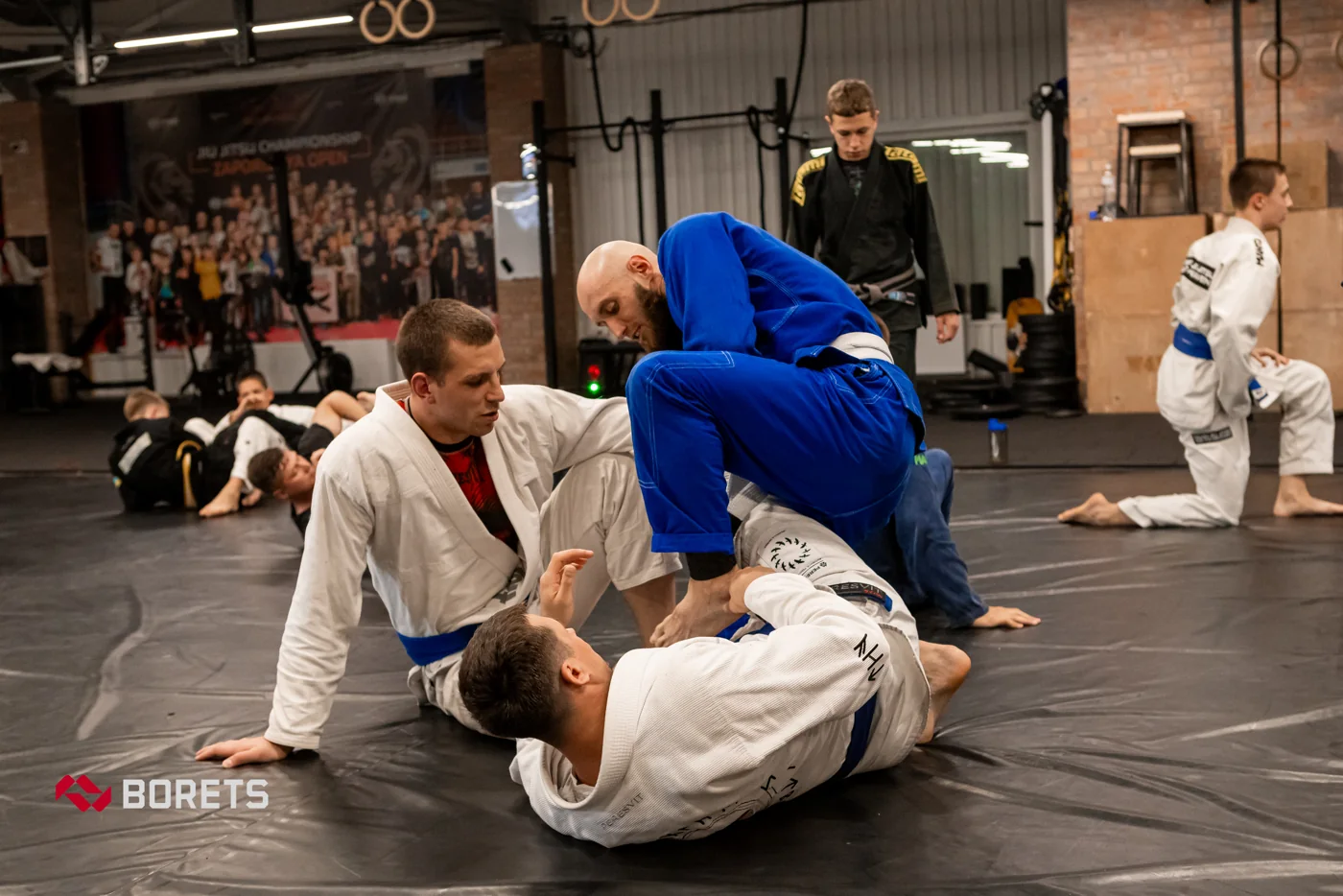
In this guide
The knee cut, also called the knee slice pass, takes one knee across the opponent’s thigh while your upper body manages their ability to turn and recover guard. The knee’s movement is only part of the pass. The position of the opponent’s inside knee, their upper-body frames and your trailing foot determine whether the route is actually open.
The entry begins after the closed guard opens
A knee cut is not a direct answer to legs still locked around your waist. First you need an open-guard or half-guard relationship in which a passing leg can occupy the space between the opponent’s legs. From there, identify the thigh you intend to cross and the leg that will remain behind during the movement.
A staggered base helps you direct the passing knee without sending your whole body forward at once. Keep the other leg available to support balance. If both knees collapse close together, the bottom player can more easily affect your base. Before cutting, check that your intended route does not run directly into an intact knee shield.
Solve the knee shield before committing your weight
The knee shield is a barrier between the two torsos. Driving straight into it can let the defender keep you at distance while their hips remain free to move. Control of the shield’s position and the opponent’s lower leg matters before you try to advance your chest.
There are several ways to address that barrier, and the appropriate choice depends on its height and your grips. Study one defined version rather than combining fragments from unrelated demonstrations. The useful checkpoint is visible: the opponent’s knee no longer blocks your upper-body connection, and your base remains stable. If the shield returns during the cut, recognize that the route has closed and reorganize.
Connect the upper body to the passing direction
The bottom player wants enough freedom to turn toward you, create an underhook or return a knee between the bodies. An appropriate upper-body connection limits those options while the passing knee crosses the thigh. An underhook on the relevant side is one common tool because it connects you to the shoulder and helps manage the defender’s turn.
Do not think of the knee and chest as separate actions. If the knee travels but the shoulders stay distant, the defender retains room to build frames. If the chest advances while the leg barrier remains intact, you may simply enter a stronger half guard. Match the two movements and keep pressure controlled, away from the face and throat.
A trapped foot means the pass is unfinished
Your knee may reach the mat on the other side while the opponent still holds your lower leg. Treat that as an intermediate position. Pulling the torso away while the foot remains trapped can disconnect your upper-body control and expose your balance.
Keep the direction of the foot and knee compatible as you work through the remaining leg connection; do not wrench a trapped joint to force the pass. Once the leg is free, establish a stable side-control relationship and follow the defender’s first attempt to turn. In the gi, cloth grips can support this process. In no-gi, you must maintain the connection through body position and arm controls.
Test the complete pass, including the landing
Give the defender two choices: rebuild the knee shield or seek the agreed underhook. Your task is to recognize which barrier has returned and adjust the passing sequence. Keep the speed low enough to identify whether the breakdown occurs at the knee, shoulder or trapped foot.
IBJJF guard-pass points require clearing the legs and stabilizing the specified control for three seconds. That is why merely reaching the far side is an incomplete training endpoint. Record which contact failed first and whether you retained the landing against the defender’s next movement. Practice under supervision, with controlled pressure and immediate release at a tap. This turns a recognizable passing motion into a repeatable positional skill.