 BORETS
In this guide
- Win a useful side position first
- The underhook connects a shoulder, not just an arm
- Read the overhook and the opponent’s base
- Connect the sweep to the top position
- Z guard: use the knee shield to build the underhook
- Quarter guard: trapping the foot is only the start of recovery
- A three-part training record
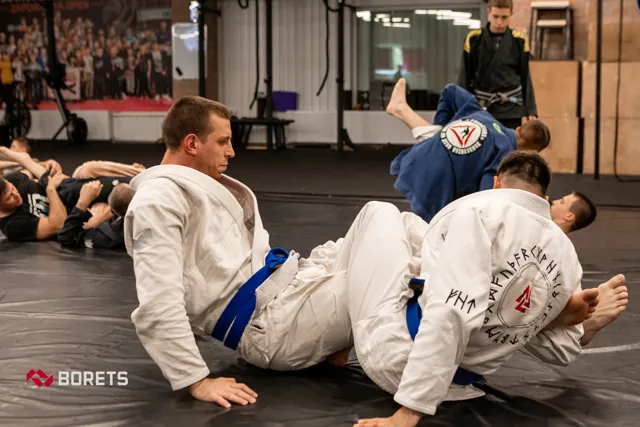
An underhook from bottom half guard gives you a connection beneath the opponent’s arm. That connection becomes useful when your torso and hips can follow it. Reaching an arm around someone while remaining flat underneath them is a very different position from coming onto your side with a supported base and a clear route toward the top.
Win a useful side position first
In half guard, your legs control one of the opponent’s legs. They do not automatically free your upper body. If your shoulders are pinned and your head is turned away, an underhook attempt may simply extend an arm into more pressure. Rebuild the inside frame and a usable facing angle before committing to the sweep.
A knee shield can help preserve space while you organize the upper body, depending on the half-guard variation. Notice when that shield can be replaced by a closer torso connection. Removing it before you have another useful contact lets the top player flatten you again. Think of the entry as exchanging supports rather than abandoning one barrier and hoping the arm grip will replace it.
The underhook connects a shoulder, not just an arm
A useful underhook places your arm beneath the opponent’s arm with enough connection to influence their shoulder and torso. Keep your own shoulder and chest involved. If your elbow reaches far away while your body stays behind, the opponent can often separate the arm from the rest of your movement.
Your head position and supporting arm also matter as you build height. Keep the head aligned with your torso and maintain a base that lets you look toward the direction of movement. Hanging the head away from the body creates extra defensive problems. The exact hand placement varies with the version, but the relationship between arm, shoulder and hips remains the essential subject.
Read the overhook and the opponent’s base
The top player may respond with an overhook, sometimes called a whizzer, or by widening their base and shifting weight. An overhook does not make the underhook useless, but it changes how freely you can rise and turn. Forcing upward through a trapped shoulder is not a solution.
Study the position with the opponent offering moderate, consistent resistance. If their weight stays over you and you cannot build a supported base, recovering a guard structure may be the appropriate next action. If you can come up without losing the leg connection, you may reach a kneeling wrestling exchange. At that point, both athletes’ supporting knees and free posts help determine the available sweep route.
Connect the sweep to the top position
Tipping the opponent is only one part of the exchange. You still need to follow their hips, free any leg that limits your movement and settle with balance. If you stop moving as soon as the opponent’s hip touches the mat, they may reverse the situation before you establish control.
Choose one sweep variation and learn its landing together with the entry. Mark which knee supports you as you rise and where the opponent can post. Keep the trapped leg comfortable and aligned throughout; do not turn the exchange into forced knee rotation. A controlled arrival in top half guard can be a useful learning result even before you work on a pass.
Z guard: use the knee shield to build the underhook
Z guard is a knee-shield half-guard family: the bottom leg retains the opponent’s leg while the top knee manages distance. Coaches use the name for slightly different shield heights and foot arrangements, so describe the actual contacts. The important question here is whether the shield creates enough space for your upper body to turn and connect.
To move toward the underhook game, exchange the distance of the knee shield for a closer shoulder-and-torso connection. Do not remove the shield while your shoulders are still flat and your upper arm has nowhere useful to go. If the passer withdraws their hips, maintain the guard rather than reaching after an underhook. If they compress the shield, address that pressure before rising. The underhook is an option created by the position, not an instruction to chase the arm regardless of the reaction.
Quarter guard: trapping the foot is only the start of recovery
In quarter guard, the opponent’s knee has cleared your leg line but you still trap their foot or ankle. Their upper body may be close to mount. Compare that with a fuller half guard, where your leg connection contains more of their leg: the available space and their control of your hips are different.
Treat the trapped foot as a temporary connection while you rebuild the position. Keep the elbows inside, turn onto a usable side and work to bring the opponent’s knee back within your leg control. A coached transition to deep half is another possibility when the alignment permits it. Clamping the ankle while remaining flat does not restore a useful guard, and twisting a trapped foot to drag the knee back is not the task. Begin the underhook sweep only after the upper-body position and leg connection can support it.
A three-part training record
Record the entry, the reaction and the landing. For example: “Reached an underhook from my side; the partner widened their base; I rose but lost the leg connection.” This identifies a specific transition to improve rather than labeling the whole sweep ineffective.
A standard IBJJF sweep from guard or half guard requires establishing the top position for three seconds. Use that rule context when preparing for competition, and check your division’s restrictions. In practice, add resistance gradually and judge whether each stage stays connected. A stronger pull with the underhook is not a substitute for the missing support that your notes have identified. Keep practice supervised, movements controlled and release immediate at any tap.