 BORETS
In this guide
Sambo is a combat sport built around taking an opponent off balance, throwing, controlling and submitting them. Some formats also include striking. That last distinction matters: a clip of a fighter throwing punches does not describe every sambo class. If you are choosing where to train, begin with the format and the way the coach introduces beginners.
Where sambo comes from
Sambo developed in the Soviet Union during the twentieth century. Its name abbreviates a Russian expression meaning self-defense without weapons. The International Sambo Federation, FIAS, marks November 16, 1938, as the sport’s official birthday. Those facts describe its historical origins; they do not mean that every modern club teaches one identical method.
Today, ask what a particular school actually practices. A competition team, a recreational group and a class that combines sambo with other grappling styles may have different priorities. The useful evidence is the training: what tasks partners receive, how resistance is introduced and whether beginners receive explanations they can apply.
Sport sambo: grappling in a jacket
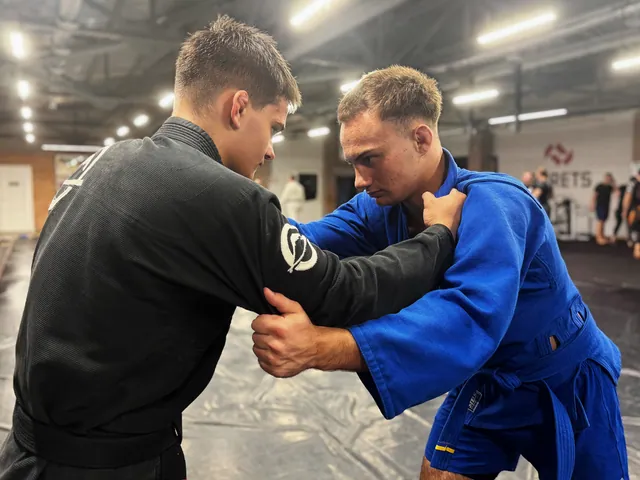
Sport sambo uses throws, hold-downs and permitted joint locks. Strikes and chokeholds are not part of this competition format. Athletes wear a jacket, shorts and sambo shoes. The jacket supplies grips; the shoes and the absence of long trousers change the contacts available compared with a typical BJJ gi session.
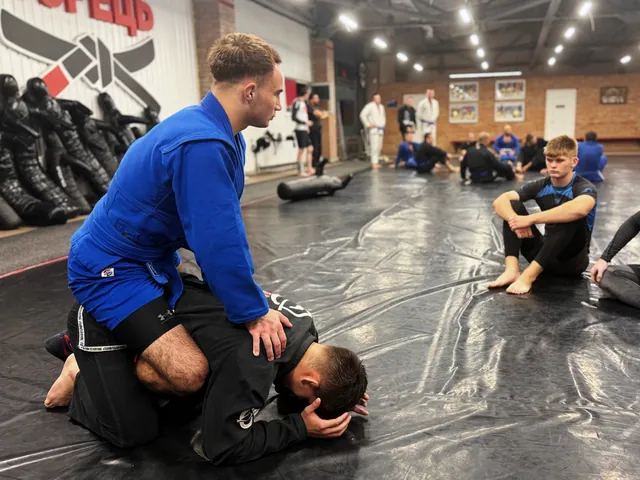
For a newcomer, watch the connection between standing and ground work. After the landing, can the athlete establish control or continue into a legal submission? Do not reduce the sport to spectacular throws or leg locks. Learning to receive a throw, recognize a stable position and release on a partner’s signal belongs in the same foundation.
Combat sambo: check the actual division
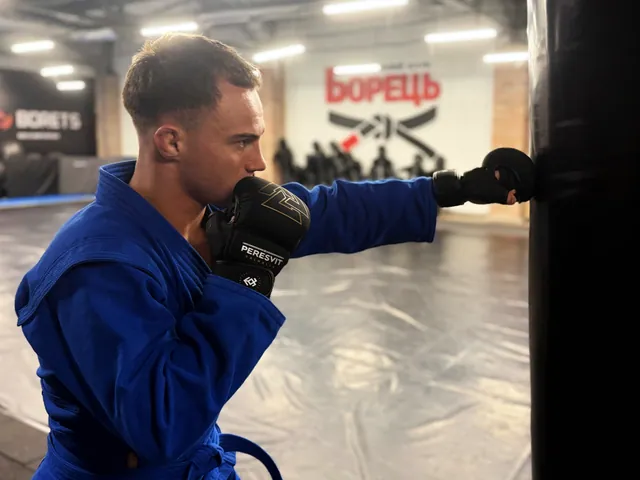
Combat sambo combines grappling with permitted strikes and chokeholds. It has its own protective equipment and restrictions. FIAS also publishes separate youth and cadet rules, so an adult match is not a template for a children’s class. Even within combat sambo, check the applicable category instead of assuming every technique seen online is allowed.
A beginner does not need to accept hard sparring to prove interest in the sport. Ask how the group separates technical learning, constrained partner work and contact practice. The coach should explain the intended contact level before the exercise starts, rather than leaving two unfamiliar partners to negotiate it during an exchange.
What a useful first month should establish
Look for a progression you can explain: moving and balancing, learning falls on suitable mats, understanding permitted grips, then connecting a manageable standing task to a ground position. FIAS’s report on its Alajuela coaching seminar specifically identifies fall-breaking and training safety as subjects for coaches working with beginners.
One useful question after class is: what made that attempt different? Perhaps your partner changed direction before your grip was settled. That observation gives you something to revisit. Counting new technique names is less informative than recognizing the starting position, the partner’s reaction and the point at which your attempt stopped working.
Who might choose sambo?
A complete beginner may enjoy learning standing and ground work together. A wrestler may want more experience connecting a takedown to a submission. A BJJ practitioner may want jacket-based standing exchanges with different competitive incentives. These are reasons to investigate a class, not guarantees about what every sambo coach offers.
For children, returning adults or athletes with particular needs, judge the group rather than the sport’s reputation. Ask about suitable partners, how tasks are adjusted and whether competition is optional. If the only available class is an advanced fight team, it may be the wrong entry point even when the instructor is an accomplished competitor.
Choose the room, then add resources
When searching in the United States, ask whether a listed “sambo” session is sport sambo, combat sambo or occasional cross-training inside another program. Confirm the schedule and beginner access directly. Bring questions about required clothing before buying equipment. An online guide can help you understand the vocabulary, but cannot assess your first falls or your partner’s control.
BORETS LAB approaches sambo within a Ukrainian grappling system that connects it with freestyle wrestling and jiu-jitsu. Use that perspective to study how one phase leads to the next. Your immediate goal can stay simple: find an appropriate training group and leave the first session knowing what you are learning and why.