 BORETS
Four surprise problems for one sambo athlete
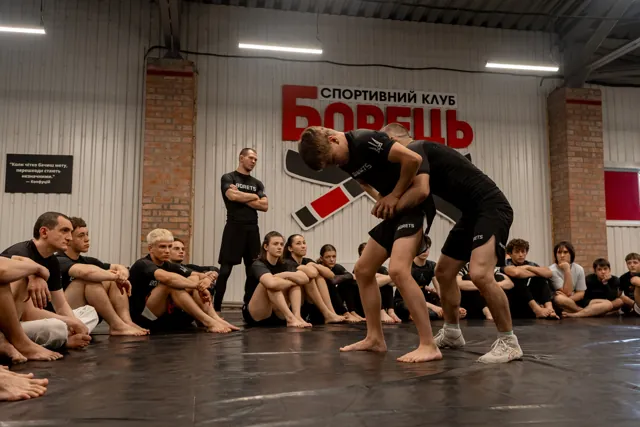
July 14, 2026Kostya Zhyvanov arrives without knowing the four tasks prepared for him. Each card changes the grappling problem: freestyle wrestling, buggy-choke defence, turtle work and a submission from standing. The episode is built around that change of context. The same athlete has to recognise a new starting condition instead of repeating one familiar kind of round.
The first card: wrestling with a size difference
At 0:58 the 74 kg sambo athlete is put into a freestyle-wrestling round with Stas, a 90 kg BJJ brown belt. The important distinction is between the opponent’s training background and the rules of this task: a BJJ belt does not make the round a BJJ match.
In his reaction, Zhyvanov reports that the size difference made the exchange difficult and that he won the opening test. That is the athlete’s account provided in the episode. It should not be expanded into an invented points breakdown or a particular winning technique.
The next cards change the starting position
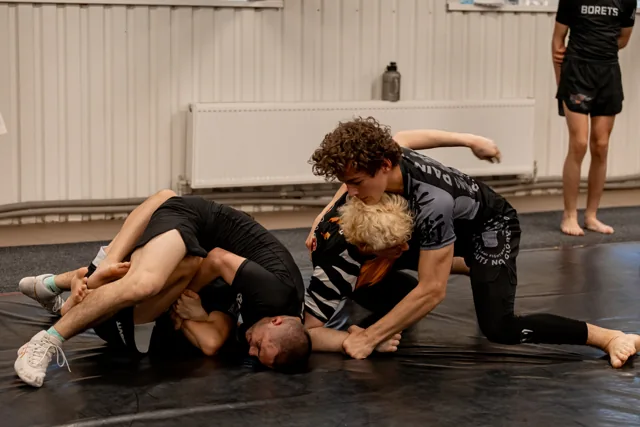
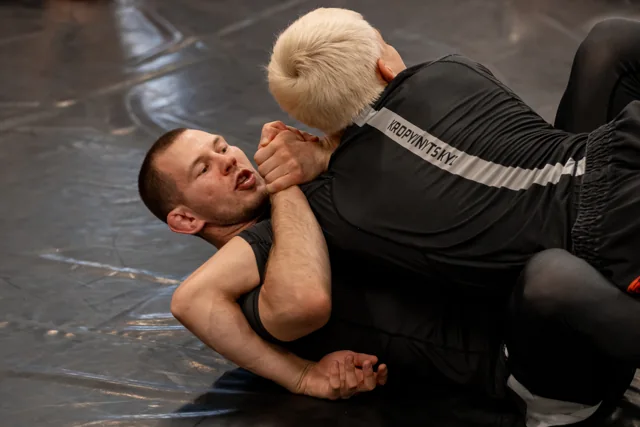
At 3:01 the task becomes escaping Anton Bereda’s buggy choke. At 3:47 Anton starts behind Zhyvanov in turtle position. The final card, at 4:54, asks for a submission from standing against Matvii, an 87 kg BJJ blue belt. These are distinct problems, not four versions of the opening wrestling round.
Watch how the objective changes with the position. In one card the athlete begins inside an established threat; in another the task begins before the fight reaches the mat. The preparation time is limited, so recognising the correct problem becomes part of the test.
The thread connecting the four tasks
The debrief at 5:44 places the session in the athletes’ long-term cross-training background. The episode’s theme is switching between wrestling, BJJ and submission-grappling decisions while keeping the task clear.
A useful second viewing follows the first decision after each card is revealed. What does Zhyvanov try to establish before the exchange develops? Compare those openings rather than inventing a single scoring system for all four tests. The format is valuable precisely because success has a different meaning in each task.
From the YouTube description
Sambo fighter Kostya Zhyvanov is back. This time, the BORETS team gives him four mystery grappling challenges—with no time to prepare: freestyle wrestling, the buggy choke, turtle position, and standing submissions. Can one Sambo fighter survive all four? Watch Episode 1—BJJ vs Sambo: https://www.youtube.com/watch?v=kPrMscGkOQI 🔴 KOSTYA ZHYVANOV — 17 years old, 74 kg Kostya has trained under Ievgen Skyrda since age six. His style is built primarily around Sport Sambo and freestyle wrestling, backed by serious BJJ and submission-grappling experience. He is an ADCC European Trials silver medalist in the adult professional division and an IBJJF Brazilian Champion in the Teen 3 green-belt division. https://www.instagram.com/zhyvanov/ 🟣 ANTON BEREDA — 17 years old, 70 kg, BJJ purple belt Anton has also trained under Ievgen since age six. He has a strong foundation in Sambo, freestyle wrestling, and BJJ, but his style focuses more heavily on Brazilian Jiu-Jitsu, guard work, and submission grappling. Anton is a multiple-time Ukrainian BJJ champion and a medalist at international ADCC competitions. https://www.instagram.com/anton.bereda/ 🥋 IEVGEN SKYRDA — coach Ievgen built the BORETS school from the ground up in Kropyvnytskyi, Ukraine. He has coached Kostya and Anton since they were six, developing both athletes through a system that combines Sambo, freestyle wrestling, and Brazilian Jiu-Jitsu. https://www.instagram.com/ievgen_skyrda/ THE FOUR CHALLENGES 🤼 Freestyle wrestling rules: Kostya faces Stas, a 90 kg BJJ brown belt 🪲 Escape the buggy choke: Anton, BJJ purple belt 🐢 Fight from turtle position: Anton again 🔥 Find a submission from standing: Matvii, an 87 kg BJJ blue belt The buggy choke story isn’t over. This Friday, July 17, we release the full experiment: a Sambo fighter, a former member of Ukraine’s national freestyle wrestling team, and a BJJ black belt will each try to escape using their own methods. Who escapes fastest—and who gets caught? Which challenge gave Kostya the biggest problem? What should we test next? Tell us in the comments 👇 No script. No predetermined winner. Just real athletes testing their skills under pressure. Subscribe and turn on notifications so you don’t miss Friday’s experiment. A QUICK HISTORICAL NOTE ABOUT SAMBO When Western combat-sports fans hear “Sambo,” they almost always label it an exclusively Russian martial art. But reducing Sambo to one modern nation is like saying jazz belongs only to New York: it erases the multinational melting pot that built it. THE SOVIET MELTING POT—NOT A RUSSIAN INVENTION When Sambo was developed in the 1920s and 1930s, it did not emerge in a Russian vacuum. Its founders traveled across the Soviet Union, combining Japanese Judo and Jiu-Jitsu with the most effective regional folk-wrestling traditions. It was a multi-ethnic project. Calling Sambo purely russian ignores the foundational DNA contributed by those diverse cultures. Ukraine was not merely a participant; it was an early incubator. In 1934, Ukrainian Sambo pioneer Roman Shkolnikov—a direct student of legendary co-founder Vasili Oshchepkov, whose father was also Ukrainian—began teaching and formalizing the sport at the Institute of Physical Culture in Kharkiv, Ukraine. Shkolnikov was more than a coach. He helped develop the sport’s rules, early training methods, and equipment. The Kharkiv school became one of the primary pillars that transformed Sambo from a military hand-to-hand system into an international competitive sport. THE SECRET ROOT OF THE NURMAGOMEDOV LEGACY Everyone knows Khabib Nurmagomedov and the dominance of Dagestani grappling. Far fewer know that the architect of that style—Khabib’s father and master coach, Abdulmanap Nurmagomedov—was forged by the Ukrainian martial-arts system. While earning a university degree in Poltava, Ukraine, Abdulmanap trained under elite Ukrainian coaches and became a Ukrainian national champion in both Sambo and Judo. The world-class coaching philosophy and grueling training habits he later brought to Dagestan to build a generation of UFC champions were deeply rooted in his years in the Ukrainian school. MODERN POWERHOUSE STATUS & THE MMA PIPELINE For a modern example of elite Ukrainian Sambo in the cage, look at Yaroslav Amosov. Before his extraordinary 27–0 MMA run and Bellator Welterweight Championship, he was a four-time Combat Sambo World Champion. His blend of unstoppable takedowns, relentless pace, and heavy-handed striking is a quintessential product of modern Ukrainian Sambo. Sambo is a global sport with a multinational heritage.
What viewers say on YouTube
Recent public comments on this video, shown in their original language. These are channel comments, not reviews of a school subscription.