 BORETS
In this guide
A wrestling exchange may ask for a hard action, a brief reorganisation and another effort before you feel fully recovered. Conditioning for that pattern is more specific than simply doing every drill until exhausted. You need a repeatable task, a clear effort target and a way to observe the drop in quality. Start with generous recovery while learning the format. Shorter rests can become a later training choice, but they should not arrive accidentally because everyone is rushing through the session.
Select a task you can measure
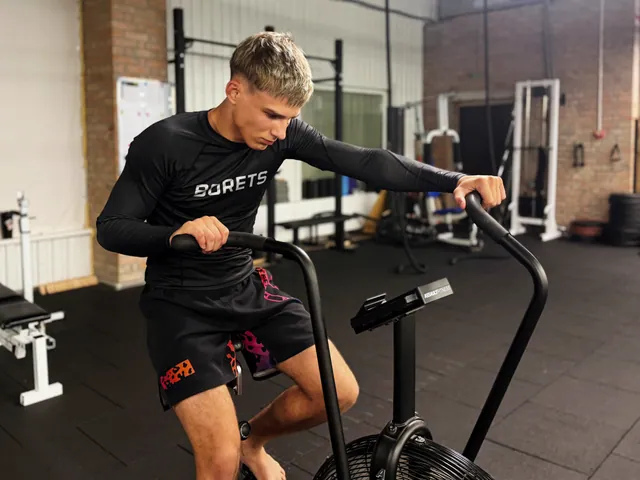
A stationary bike is useful because it removes partner decisions and landing demands. Use the same seat setting and resistance when comparing efforts. Record average power if available, or a consistent cadence measure rather than a fleeting peak. On the mat, use a familiar movement such as controlled stance steps and entries without a finish. Count only repetitions that meet the agreed technical criteria. A messy extra entry is not an improvement in conditioning; it changes what you are measuring. Use the same task across several sessions so a change reflects more than unfamiliarity.
Begin with a manageable interval example
For a healthy adult accustomed to hard exercise, one introduction is four to six bike efforts of ten seconds at a strong but repeatable pace, separated by 80–90 seconds of very easy pedalling. Warm up progressively and include a few short, easier accelerations first. This is a learning session, not an all-out test or a complete competition plan. Use fewer efforts after a layoff. Extend recovery when needed. The goal is to learn what consistent output feels like before making the recovery deliberately incomplete.
Use partner work for a defined problem
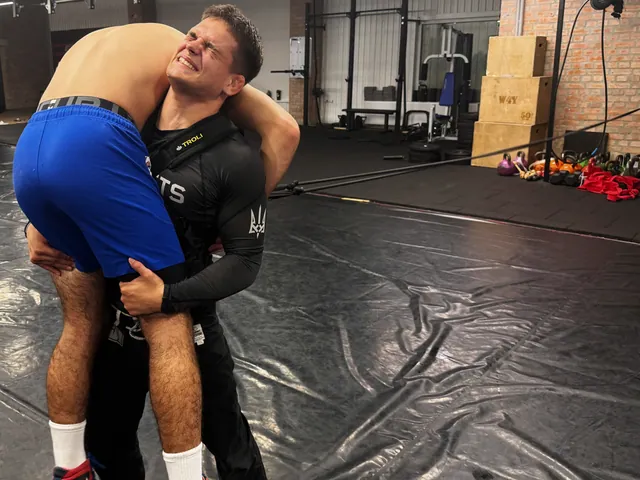
A partner version might be a short attempt to gain an underhook and a useful angle from an agreed light tie, followed by release and reset. Both people know the task, contact level and stop signal. Do not combine maximal fatigue with unfamiliar throws, neck pressure or submission finishes. Initially give enough rest to repeat the technical pattern clearly. Later, the coach can change the defender’s response or the rest period, one at a time. A live round already has its own conditioning cost.
Recognise when the session has changed purpose
If output falls sharply, stance collapses or every effort requires an extra recovery step, pause and reassess. You can lengthen rest, lower the target or end the block. Repeated-sprint research often uses incomplete recovery, whereas pure speed work prioritises longer recovery; those are different prescriptions. There is no single work-to-rest ratio that reproduces every grappling match. Match the session to the current aim: repeat controlled efforts, improve an established conditioning capacity, or practise decisions under a carefully chosen amount of fatigue.
Progress within the whole training week
Start with one short added block in a week that has room for it, not after every class. Log work duration, rest, task quality and the next day’s response. Once the session is stable, add one effort or modestly shorten the pause, never both automatically. Near competition, coordinate this with the existing hard rounds instead of adding a new exhausting protocol. Children need their own play-based, supervised format. Stop for pain, dizziness or unusual symptoms; conditioning is not a reason to ignore them.