 BORETS
In this guide
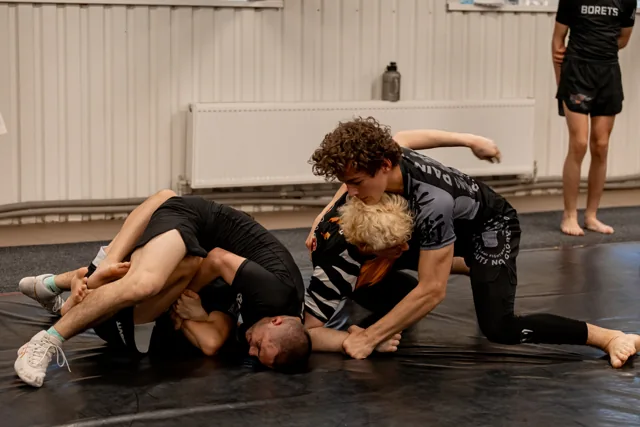
An opponent on their knees and hands can hide the elbows, shift their weight and change which arm supports them. A sambo armbar from this turtle position begins with solving that control problem. Grabbing a wrist is only a possible connection. The question is whether you can isolate the arm while staying balanced and keeping the defender’s shoulder from freely following the hand.
Identify which turtle you are facing
A compact defender with elbows close to the body offers different openings from a partner posting a hand to recover balance. Do not treat these as the same starting position. Observe whether the target arm is supporting weight, already exposed or tucked beneath the torso before selecting a transition.
The armbar discussed here ends in elbow control, rather than a shoulder lock. IJF’s juji-gatame reference is useful for recognizing the familiar cross-armbar family, but does not prescribe one sambo turtle entry. Ask your coach to show the chosen entry and the eventual controlling position as two separate stages.
Three controls that should remain visible
First, follow the elbow: can it retract toward the defender’s ribs, or has the upper arm actually been separated from the body? Second, follow the shoulder: if the entire shoulder turns with the hand, a wrist grip may be moving the person without isolating the elbow.
Third, check your base during the change of position. You need a way to support and move your own weight without suddenly dropping it onto the trapped arm. A useful demonstration can pause before and after the transition. If it works only as a fast fall, ask for the missing control to be explained.
Do not force a concealed arm into the plan
When the defender closes the elbow, the original opening may have disappeared. Pulling harder can turn a positional question into an uncontrolled strain on the shoulder or elbow. Keep the distinction between retaining top control, creating a new opening and committing to the submission. These are separate decisions.
For example, if the defender turns toward you and brings the arm back under the torso, the useful continuation may be another control position. That does not make the armbar study a failure. You have identified the reaction that closes the entry and can work on recognizing it earlier.
Test the transition before the finish
Have the coach choose an appropriate starting turtle and one permitted defensive reaction. The attacker’s task is to reach a stable arm-control position or return to top control. Stop before elbow-extension pressure. The defender should know the task and be able to signal at any moment; a sudden roll with a trapped arm is not the test.
Compare attempts by asking where control changed. Did the elbow disappear first? Did you lose balance while changing sides? Did the shoulder follow because the upper arm was never isolated? Record one observation and repeat the same entry with the coach’s correction, instead of immediately adding another finish.
Carry the idea into your ruleset
Sambo, BJJ and submission-grappling rules can give different incentives around turtle. An athlete protecting against a pin may react differently from one defending back control. Keep the observed reaction attached to its context rather than assuming a training partner from another discipline will behave identically.
Check the applicable age group and submission rules before use. FIAS sport-sambo rules define when an arm attack must stop as the athletes stand, and prohibit throwing with a grip established for a painful hold. Learn the transition under supervision; do not use the arm as a handle for an uncontrolled takedown.