 BORETS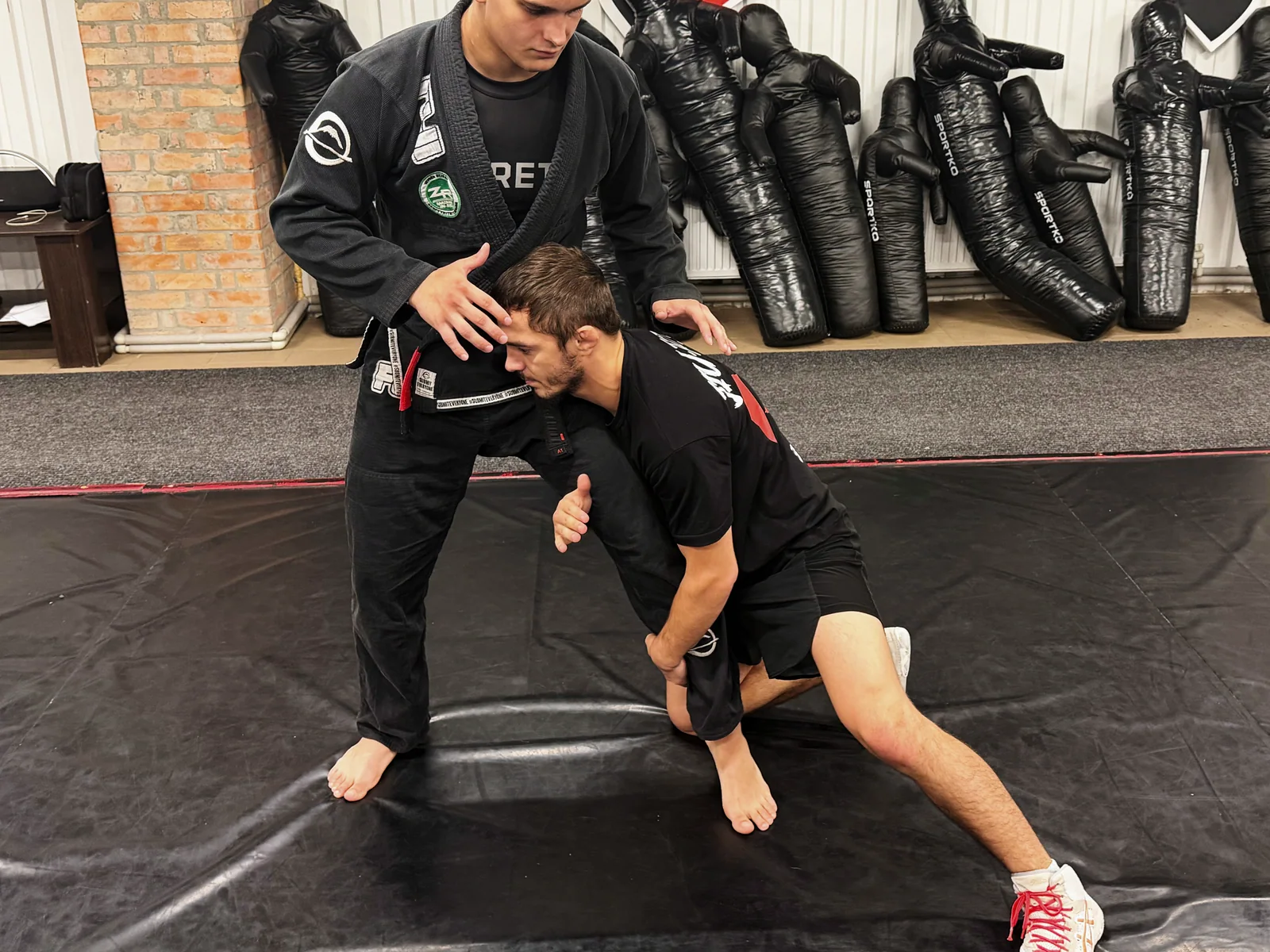
In this guide
A single-leg takedown attacks one leg, but the position involves both athletes’ whole bodies. The defender can hop, turn, push the head or apply an overhook. Holding the leg tighter does not answer every reaction. A useful starting model is a head-inside single in which you collect the leg, recover a balanced stance and choose a finish according to the defender’s remaining support.
Make the target leg accessible
Start by identifying which leg is forward and where the opponent carries weight. Move the hands and shoulders to encourage a step, then close the distance with your feet. The aim is to arrive beside the target leg without stretching both arms from a distant stance. If you need to chase the leg around the mat before making contact, return to your setup. A small change in the opponent’s stance can matter more than a faster shot from the same unhelpful distance.
Collect the leg and rebuild your stance
Change level with your legs and establish close contact around the target. In the head-inside version, keep the head connected to the inside of the opponent’s torso with the neck aligned, and bring your hips underneath you as you rise. Keep the captured leg close enough that your arms do not become a long lever. The foot position and hand connection should be demonstrated by your coach. Avoid lifting with a rounded back while the opponent’s weight hangs far from your body.
Read the supporting foot
Once the leg is collected, look at how the defender maintains balance. A supporting foot that keeps stepping can be moved in a different direction; a stable, heavy base may require a new angle before a finish becomes available. Work with the opponent’s hip and whole-body position. Twisting the captured foot while the knee remains trapped is not an appropriate substitute for moving the opponent. For an introductory finish, ask the coach to select a low, controlled option that both partners can receive.
Respond to the overhook without forcing the shoulder
The defender may place an overhook over your collecting arm and turn their hips away. Notice whether your elbow is being pulled away from your body and whether your head has lost its useful position. Recover your alignment, adjust the angle or release and reset. Continuing to lift while your shoulder is trapped can make a poor position worse. In practice, give the defender only a light overhook at first so the attacker learns to recognise the change before encountering stronger resistance.
Keep the transition in the exercise
After a controlled finish, continue until you can account for the defender’s hips and their attempt to face you. Do not stop the repetition simply because a hand touches the mat. Equally, do not keep driving when your partner has lost the agreed landing route. In freestyle, study the scoring consequence of the whole action with your coach. If adapting the single leg to BJJ, revisit head placement and exposure to submissions rather than assuming a wrestling grip settles those questions.
Test connection before adding finishes
Begin from a stationary collected-leg position with the defender balanced and cooperative. Practise posture and a safe release. Add slow steps, then one agreed defensive response, and finally the coach-selected finish. Children and inexperienced partners can work on entry, balance and release without hopping battles or elevated finishes. Log where control disappeared: at the hands, head, hips or supporting foot. That gives the next session a specific task and helps avoid accumulating repetitions of a position that never becomes stable.