 BORETS
In this guide
A good wrestling stance leaves several actions available: step, circle, change level, attack or defend. A position that looks low and athletic can still fail if moving requires a preliminary jump or a large transfer of weight. Evaluate the stance by what you can do from it, then add footwork one decision at a time.
Find a base you can leave in any direction
Start with a comfortable stagger, knees and hips bent, head aligned with the trunk and hands available in front. Keep enough distance between the feet to support balance without forcing a long first step. The exact height depends on the situation and athlete; sinking lower is not automatically an improvement if it removes mobility.
Check forward, backward and sideways movement without changing the stance first. If one direction feels blocked, examine foot spacing and where your weight rests. USA Wrestling treats stance, motion and level change as connected fundamentals. The purpose of this progression is to make that connection observable rather than hold a single pose for time.
Step, recover the spacing, then step again
For the basic drill, let the foot nearest the direction travel first, then bring the other foot along without crossing or closing the base completely. Use short steps. Crossing may appear in other athletic movements, but in this introductory task it makes it harder to preserve an immediate defensive option.
Mark a small rectangle and travel around it in both directions. Pause at each corner. You should be able to change direction without standing tall, hopping or putting a hand down. If a corner exposes a problem, reduce the step size and repeat that transition instead of completing more laps with the same error.
Circle while keeping the target in front
Place a marker to represent the opponent. Circle with small steps while keeping your chest and hands oriented toward it. The path changes your angle; it should not turn into running sideways with your back partly exposed. Pause unpredictably and check whether either foot can initiate the next movement.
Then change the distance slightly: circle closer, move away and recover a usable range. Reaching with the hands while the feet stay behind creates a different problem from moving the whole base. Against a partner, hand fighting should be connected to your feet rather than performed from a frozen stance.
Add the level change without diving
Lower through the knees and hips while keeping the head aligned, then return to the original level. Do this after a step and after circling. If the head drops because you folded only at the waist, shorten the movement. A level change should leave you balanced enough to enter, move again or abandon the attempt.
Let a partner supply the next decision
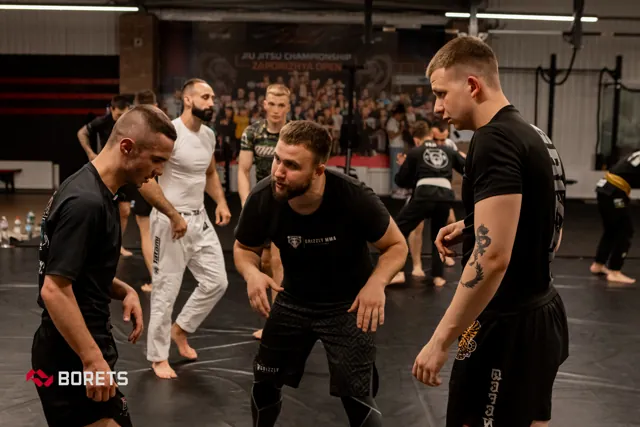
Progress to a noncontact mirror drill: one partner changes direction and distance, the other maintains stance and orientation. Add only light, agreed hand contact after both can stop reliably. Use suitable mat space and controlled intensity; no surprise shots are needed. Test whether your footwork responds to another person instead of merely reproducing a memorized route.