 BORETS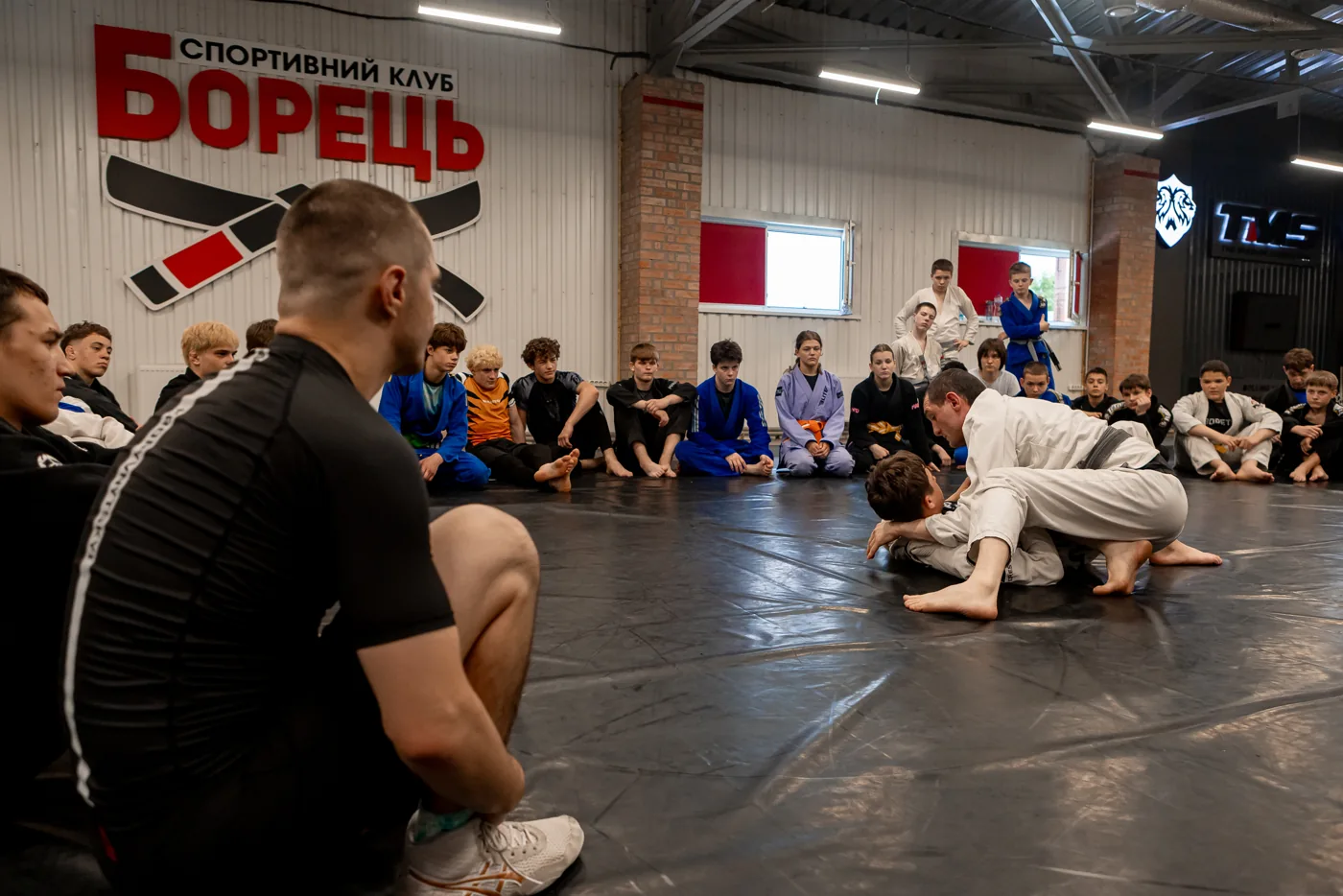
In this guide
Closed guard is the position where the bottom player crosses the ankles behind an opponent's torso. It gives you a connection for controlling posture, attacking and sweeping, but crossing the feet alone does not put you in charge. Useful closed guard combines the legs, grips and hip movement, then changes position when another opening becomes more useful.
Connection, posture and angle
Crossed ankles connect you to the opponent without immobilising their hips. Upper-body grips help manage posture; your hip angle changes which attacks are available. Collar and sleeve grips are common in the gi; wrist control, head control and overhooks offer other connections in no-gi.
An angle is useful when it serves an action. Can the opponent stand freely? Can they withdraw the arm you want? Are they close enough for your next movement? Those questions give each grip a job rather than making closed guard a holding pattern.
Breaking posture with coordinated movement
Pulling only with the arms can become an exhausting grip contest. Coordinate the legs and hips with upper-body control, particularly when the opponent reaches, shifts weight or starts standing. Your grips help maintain the resulting opening.
Practise against a partner whose task is only to maintain posture. Notice whether you can disturb their balance without overreaching, and whether you control an arm afterwards. Breaking posture is useful when it creates a next action; it does not require keeping the head low for a whole round.
How opponents open closed guard
Standing openings use balance, posture and pressure on the legs. Kneeling openings use a stable base with coordinated hip and leg control. Learn the details of one coach-taught version before combining them.
The top player is not automatically unable to submit from inside closed guard: attacks exist, although reaching for them can expose the attacker. Crossed ankles are not a guarantee of safety. Under IBJJF rules, a qualifying sweep scores two points and a completed guard pass three, subject to the scoring conditions and stabilisation.
Keep it closed or open deliberately
As the opponent stands or removes a grip, decide whether you can maintain useful control or should transition. Holding on with the feet after losing every other connection leaves the timing to them.
Practise one planned opening: retain a grip, place a frame or hook and arrive in an open guard you recognise. If you learn a higher closed-guard variation, study its particular arm control and posture requirements instead of treating it as a neck-squeezing contest.
Build a chain around a reaction
Kimuras, hip-bump sweeps, armbars, triangles and scissor sweeps can begin from closed guard, but they are not a fixed sequence. The opponent's posture and arm position determine which option is available.
Choose a two-option sequence with your coach. One response offers the first option; a different response offers the second. Initially the partner alternates predictably, then chooses freely. Learn to recognise the trigger without forcing the next move when its requirements are missing.
Train control, then decisions
Use short positional rounds: first maintain useful control against posture changes, then practise a transition against a familiar opening. Add attacks and varied resistance as both partners learn the sequence.
Track what breaks first: a grip, your hip angle, the leg connection or your ability to follow a change of height. That observation gives a coach a clearer problem than asking why your closed guard never works.
Register for the BORETS LAB launch to join our team wherever you train. Membership will let you choose Ievgen Skyrda, Oleksandr Oliinyk, Kostiantyn Zhyvanov, Yaroslav Blazhko for children's development, or Mykola Chaban for freestyle wrestling. Send a specific question and receive a private written answer in your account; when useful, the team can record a video addressing it.