 BORETS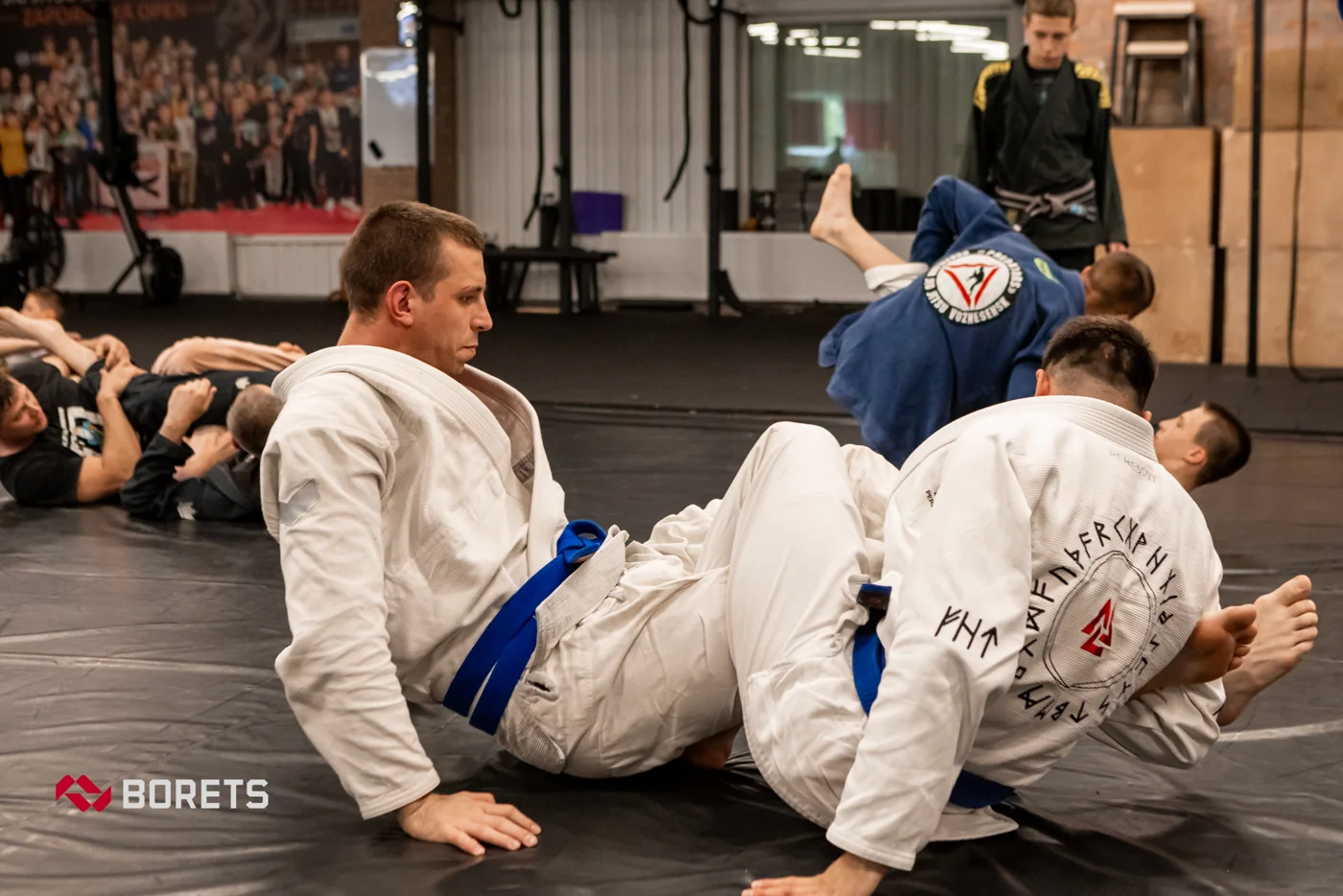
In this guide
A BJJ guard is a position in which the bottom player uses the legs to control distance, limit passing and create attacks or sweeps. Closed guard, butterfly and half guard solve different problems. Learn what connects you to the opponent, what can break that connection and where to go next: the names then become a useful map rather than a list to memorise.
Closed guard: connection and angles
Closed guard crosses the ankles behind the torso. Leg and upper-body control help manage posture, isolate an arm and create angles for attacks or sweeps. Closed ankles do not remove the top player's ability to move or attack. If the opponent begins opening, decide whether to maintain useful control or transition deliberately while keeping a grip or frame. Squeezing the ankles together is not a substitute for those connections.
Problem: they are standing or backing away. Open guard basics
Open guard is distance management with the feet. Feet on the hips and biceps keep them off you; grips on the sleeves, collar or ankles pull them back in. In the gi, collar-and-sleeve guard pairs a foot on the bicep with a sleeve grip and sets up triangles and sweeps. De la Riva hooks your outside leg around their lead leg to tilt them, and spider guard controls both arms with feet on the biceps; know they exist, learn them later. Every open guard has the same task: feet between you and them, off-balance them, make them step where you want.
Butterfly guard: inside hooks and balance
Butterfly guard commonly places the insteps inside the opponent's thighs. Upper-body connection and a change of angle let the hooks assist off-balancing and elevation. Lifting a foot without controlling posture or base is usually insufficient. Seated butterfly is a common introduction, but butterfly hooks also work during transitions and from half guard; they do not become useless whenever your back approaches the mat. Learn a sweep and a recovery when the opponent changes height or steps out.
X-guard and single-leg X
These guards often appear against a standing opponent. Both use leg connections to disrupt balance, but their configurations and options differ. Learn how to enter, how to prevent the opponent stepping free and how to finish on top. Leg-lock options have separate restrictions. Under IBJJF rules, foot placement, a trapped foot and direction of pressure determine whether a configuration is knee reaping; crossing a foot alone is not the complete rule.
Half guard and knee shield
Half guard controls one of the top player's legs. It can be an attacking choice or a recovery during a pass. A knee shield uses the upper leg as a frame to manage distance; other variations work closer with underhooks and upper-body connection. Being flattened with the head controlled makes many options harder, but half guard is more than an unfinished pass. Practise one recovery to a stronger guard and one sweep or stand-up, choosing according to the available grips and space.
Quarter guard and octopus guard
Quarter guard usually means only the lower part of the opponent's leg or foot remains trapped. That can delay a pass or help recover a deeper connection, but upper-body control still matters. A caught foot is not a complete defensive plan.
Octopus guard commonly involves turning alongside or behind the opponent's torso and reaching around the back from half guard or a related position. It is not simply an overhook while lying flat. It has its own sweeping and back-access opportunities; study the entry and balance requirements before adding it.
When the guard has been passed
Side control and turtle are not guards. From a pin, frames, angle changes and hip movement may help bring the legs back between you. From turtle, you also need to manage attacks on the neck and back while finding a route to guard or a stand-up. Neither recovery is automatic. When a guard connection breaks, recognise the new escape task instead of continuing an attack that is no longer there.
Choose a connected pair to practise
Choose two guards with your coach based on the positions you encounter, your movement and your rules. Closed guard plus an open guard teaches deliberate opening; knee-shield half guard plus butterfly teaches changes in distance and connection. Body proportions affect comfort without dictating which guards you can learn.
Practise the link in both directions. Ask your partner to make one predictable change, then vary it gradually. Track whether you preserve a meaningful connection and arrive in a position you recognise. If you repeatedly lose the same transition, describe what changes: a grip removed, the opponent standing or your hips flattened. That makes a coaching answer actionable.
Register for the BORETS LAB launch to join our team wherever you train. Membership will let you choose Ievgen Skyrda, Oleksandr Oliinyk, Kostiantyn Zhyvanov, Yaroslav Blazhko for children's development, or Mykola Chaban for freestyle wrestling. Send a specific question and receive a private written answer in your account; when useful, the team can record a video addressing it.