 BORETS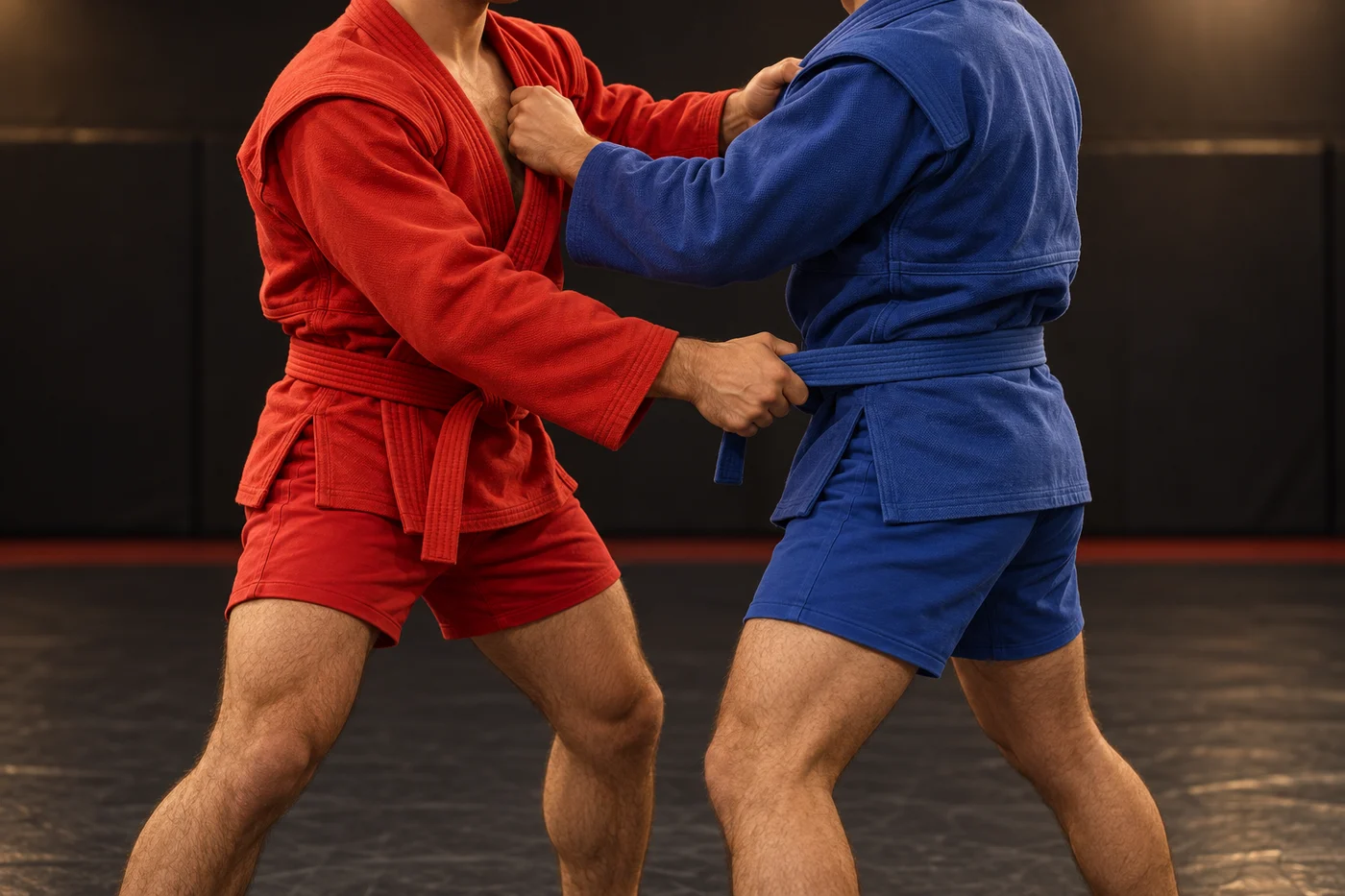
In this guide
A useful sambo game connects contact, movement, a throw and the position that follows. A list of techniques is helpful only when you understand where each one belongs. This map follows sport sambo from the first grip to groundwork and links ten focused guides. The goal is to choose the next action from the partner’s response, rather than force every exchange into the same finish.
1. Establish a connection that lets you move
Begin with stance, distance and a grip you can hold without losing posture. The belt grip guide examines a connection around the waist; sleeve and jacket control can complement it. Ask what your free hand controls and whether your feet can still follow a change of direction.
A grip is not itself a throw. If you reach the belt but your head and chest fall away from your base, the connection may help the opponent move you. First practise moving together, releasing when the position deteriorates and rebuilding contact. Then add a clearly chosen attack.
2. Read the support: trips and foot sweeps
The inside trip attacks from between the opponent’s legs; the outside trip works from outside the stance. Both need the upper body to direct balance while the leg action interferes with support. Reaching farther with the attacking foot cannot compensate for an opponent whose body remains free to step away.
A foot sweep emphasizes a changing support during a step. Think of the distinction as a question to test: is the target foot carrying stable weight, becoming light or moving into place? The linked guides separate these situations. Do not treat every leg action as the same technique or solve missed timing by kicking harder.
3. Turn with connection: hip and shoulder throws
Hip and shoulder throws organize a turning entry around different body connections. In the hip throw, examine how the opponent arrives on the hip connection. In the shoulder throw, examine how the upper body remains attached during the turn. Turning quickly while leaving a gap is not the same as loading a controlled throw.
Practise the entry and a safe return before demanding a complete finish. A partner who steps away or blocks rotation gives useful information. Learn to abandon the attempt without uncontrolled twisting or falling onto the partner. The missed entry belongs in the lesson as much as the successful throw.
4. Recognize what the landing actually gives you
After a throw, check your base, the opponent’s orientation and which connection remains. The next task might be stabilizing a hold-down, following a turn or recovering your own position. Sport sambo scores qualifying hold-downs and permits specific arm and leg submissions; it does not permit chokes.
Do not jump toward a familiar submission merely because the opponent is down. If they turn to hands and knees, the armbar-from-turtle guide begins with isolating the arm while preserving control. If a leg becomes available, the throw-to-leg-lock guide asks whether the landing actually supports that transition.
5. Understand the names before copying the finish
The English label “straight ankle lock” describes a different submission from a kneebar. The first focuses on the ankle-region finishing action; the second extends the knee. The control position, permitted configuration and defender’s movement matter in both. A name alone never establishes legality or safety.
In multilingual study, use the descriptive name together with the starting position. “Belt grip,” “hip throw” and “armbar from turtle” identify a useful family or situation, not every possible variation. Learn the position with a partner and coach, use early taps and immediate releases, and separate control practice from finishing pressure.
Build one connected practice sequence
Choose a grip, one throw and one ground objective from the guides below. Begin with cooperative entries, then let the defender choose between two agreed responses. Reset when control disappears instead of forcing the sequence to continue.
Log the point of failure: connection, balance, entry, landing or ground control. Change one detail and test again. For young athletes, the coach selects age-appropriate throws and ground tasks; an adult submission map is not a children’s progression.