The direct answer
Use the positional hierarchy to decide what to protect, escape and attack first.
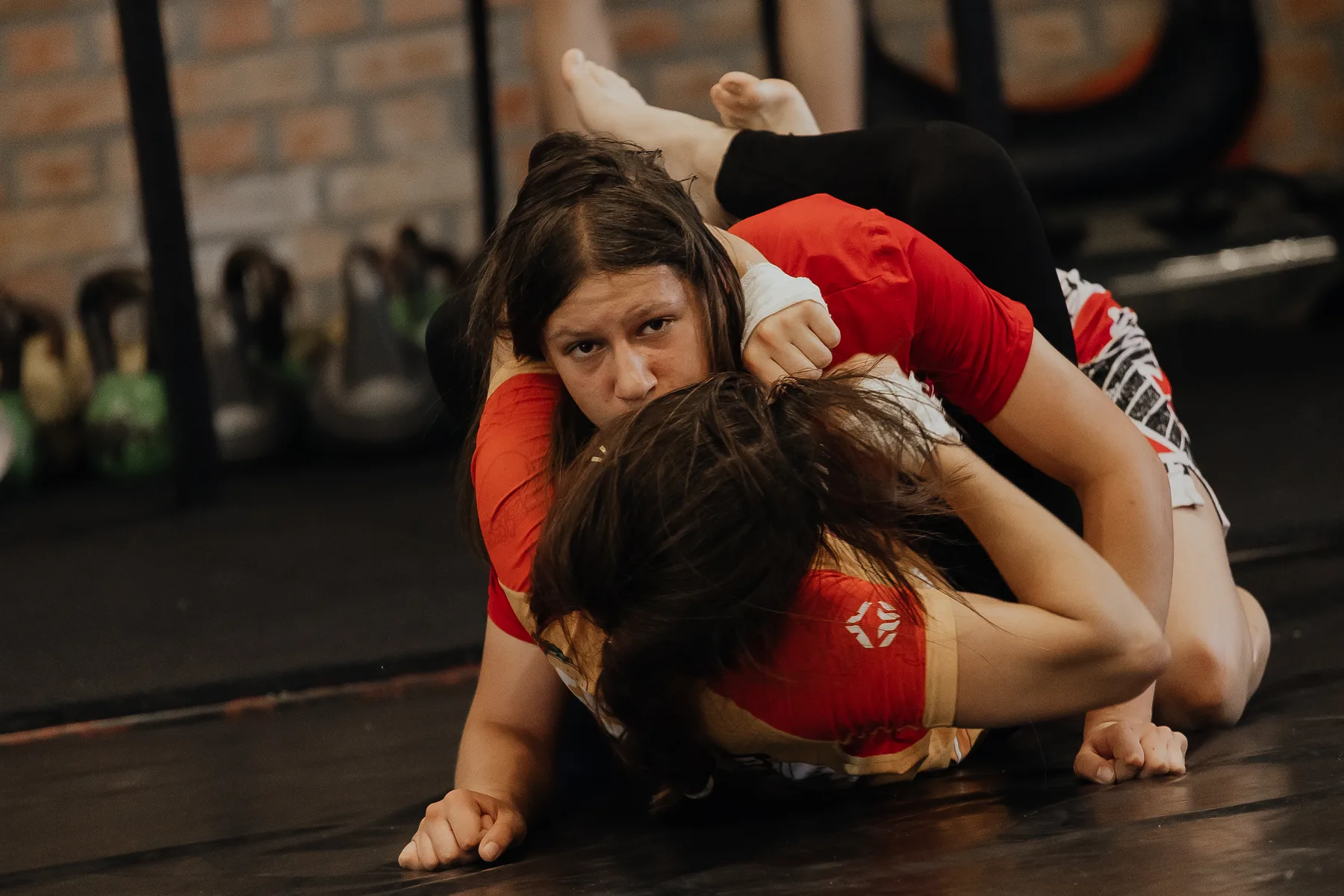
Half guard is not one position; it is a family of relationships where one of the top athlete’s legs remains entangled. A beginner can organize the family around three battles. First is upper-body position: head placement, frames, underhooks and crossface-style control determine whether bottom can turn in or top can flatten. Second is the knee line: bottom wants a useful leg connection and hip mobility, while top wants to free the trapped knee and prevent guard recovery. Third is direction: bottom may come underneath, turn to a side, build to an underhook or recover a fuller guard; top may flatten, free the knee, switch angle or settle a pass. The immediate priority depends on posture. A flattened bottom athlete should rebuild frames and side position before chasing a sweep. A top athlete with poor head and hip alignment should stabilize before forcing the foot free. Both sides need an exit when joint alignment becomes unsafe. Avoid twisting the trapped knee, crushing the neck or driving through pain. Use gradual pressure, early tapping and instructor-approved leg positions. Rules on reaping, leg attacks and scoring vary by organization, belt and age; verify the current official event materials and do not infer values from this technical guide. This page explains first battles and decisions, distinct from a broad guard-passing system or a catalogue of half-guard sweeps.
01
What to understand
Win a usable side position
Bottom needs frames and shoulder angle to move; top uses head and upper-body control to limit that turn without unsafe neck pressure.
Understand the underhook battle
An underhook is useful when connected to head, hip and knee position. Reaching alone can expose the back or arm.
Track the trapped knee line
Top knows whether the knee is free enough to pass; bottom knows whether the legs still control meaningful hip movement. Feet alone can be misleading.
Choose direction from pressure
Bottom turns, comes underneath or recovers guard based on top’s weight. Top flattens, switches or clears the knee based on bottom’s frames.
Finish the transition safely
A pass settles hip and shoulder control; a sweep arrives in balanced top; a recovery establishes a recognizable guard. Stop if the knee twists.
02
How to train it
Battle 1 · side versus flatten
Bottom scores shoulder angle and frames; top scores safe flattening alignment. No leg freeing or sweeps are allowed.
Battle 2 · connected underhook
Bottom gains an underhook only while protecting head and back exposure. Top responds with position, not uncontrolled neck pressure.
Battle 3 · knee-line freeze
Coach pauses common half-guard transitions. Athletes identify whether the knee is trapped, emerging or free and name the next project.
Battle 4 · two-direction bottom game
Top shifts pressure forward or backward. Bottom chooses underhook build, underneath angle or guard recovery without forcing the knee.
Battle 5 · pass or recover
Start at a neutral half guard. Top scores stable control after clearing the knee; bottom scores known guard recovery or balanced top position.
Side position before sweep ambition.
Underhook, head and hips work together.
Read the knee line, not only the feet.
Pressure chooses the useful direction.
No transition is worth a twisting knee.
03
Common mistakes
Accepting a flat bottom position
Frames and hip movement disappear while top organizes pressure. Rebuild structure and a side before reaching for distant attacks.
Reaching an underhook with the back exposed
The arm connection lacks head and hip support. Build the frame, protect the far side and connect the whole body.
Forcing the trapped foot
Twisting below a controlled knee can create unsafe joint pressure. Improve the knee line and hip angle before extracting the foot.
Calling the pass before control settles
Clearing the leg without hip and shoulder control allows immediate recovery. Connect the pass to a stable next position.
04
Questions athletes ask
01 · Is half guard a good position for beginners?
Yes when taught through frames, side position, knee-line safety and simple directions. It also appears naturally during passing and recovery.
02 · Does bottom always need an underhook?
No. It is one powerful connection, but top pressure and the specific half guard may call for frames, an underneath path or guard recovery.
03 · When is half guard passed?
Use official event rules for scoring. Technically, top must clear the meaningful knee line and settle control that denies immediate recovery.
04 · How do I protect the knee in half guard?
Keep alignment, avoid forced twisting, communicate early and release the entanglement when pressure cannot be controlled. Learn positions from a qualified instructor.
05
Sources and further reading
Training needs vary by athlete, schedule and coaching environment. Use these sources as context, then adapt with qualified support. Educational content for athletes and coaches. This guide does not diagnose injury, replace individualized coaching or override event rules. Stop if an activity causes pain, and use an appropriately qualified coach or healthcare professional for your situation.