
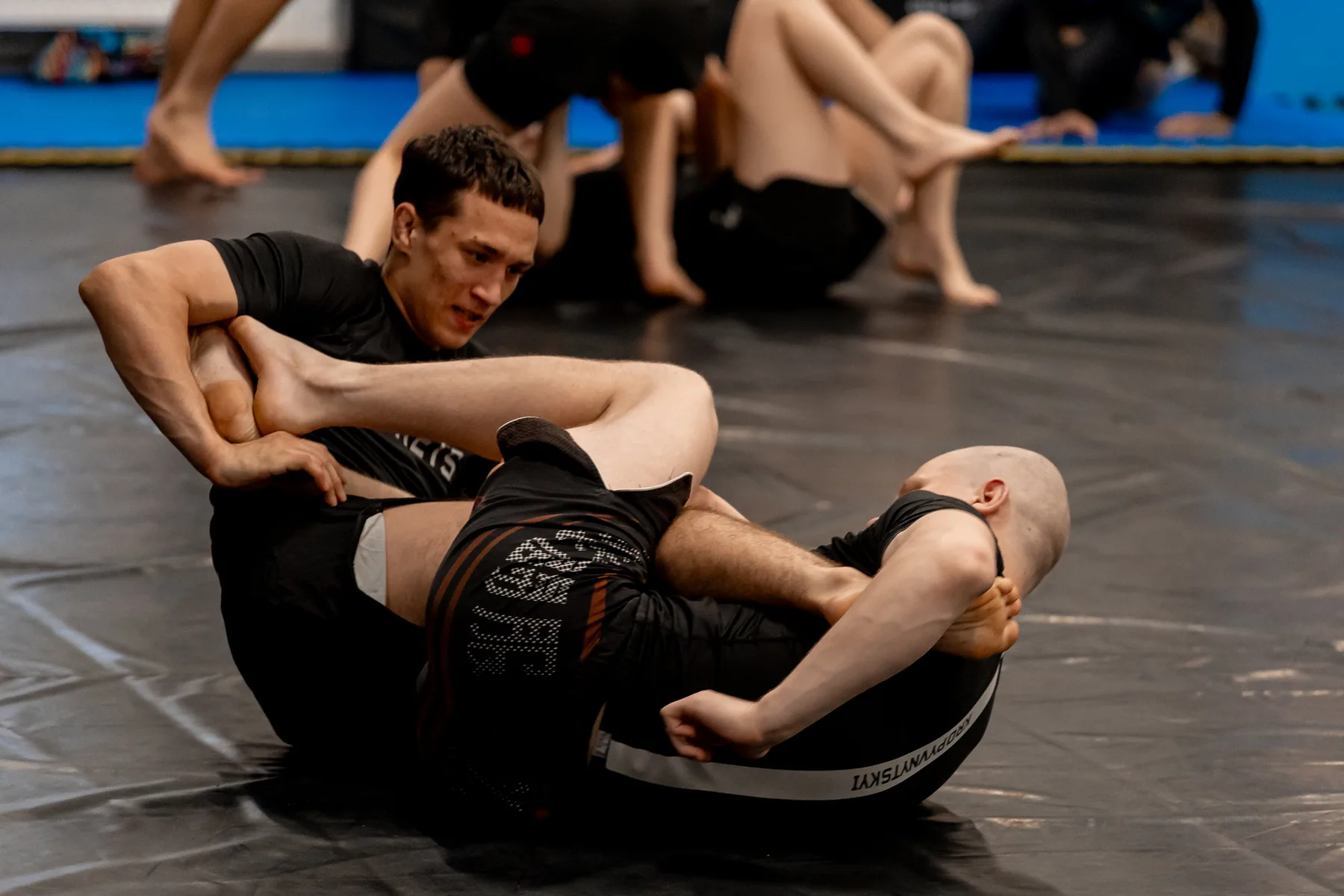
The direct answer
Check the event rules before choosing takedown, guard and leg-lock priorities.
A no-gi front headlock is first a control position, not an instruction to squeeze the neck. The top athlete connects the opponent’s head and one arm while keeping balanced feet, hips back enough to resist a shot and elbows in safe alignment. Head position and angle prevent the bottom athlete from simply circling or rebuilding posture. From this control, the first branches are positional: snap to a stable front-head position, circle to a go-behind when the near side opens, block a sit-out or reshot, or transition to a submission only when the neck and arm configuration is clearly understood. The bottom athlete protects the neck, restores posture, clears control and chooses a safe turn, sit-out or leg re-attack without rolling blindly. Submission training must be conservative. No sudden guillotine squeeze, neck crank, jaw twist or bodyweight drop is permitted. Apply connection gradually, allow immediate verbal or physical tapping, release on the first signal and avoid finishing through defensive rotation. Partners should agree on a verbal stop before the round because both hands may be occupied during the position. Legal chokes and neck attacks vary by age, experience and organization, so verify current official rules and use only instructor-approved options. Train positional control and go-behinds before any submission finish. This page is no-gi and control-first, distinct from a broad wrestling front-headlock catalogue or a leg-entanglement system.
01
What to understand
Connect head and arm without neck torque
Use chest, forearm and hand position to control posture while the cervical line remains safe. Control should not depend on cranking.
Build balanced feet and hip position
Stay mobile enough to circle and heavy enough to prevent an easy reshot. Kneeling square can surrender angles and base.
Use angle for the go-behind
Move the opponent’s head and near shoulder off line, then circle while preserving arm control. Do not jump over uncontrolled posture.
Read sit-out and reshot reactions
The bottom athlete’s hip turn or leg connection changes the branch. Follow position, block the angle or reset rather than squeezing harder.
Enter submissions from stable control
Only transition when grip, arm and neck alignment are understood and the partner can tap. Release immediately if rotation changes safety.
02
How to train it
Stage 1 · posture control
Top establishes head-and-arm connection without choking. Bottom rebuilds posture slowly while both monitor neck comfort.
Stage 2 · go-behind angle
Top moves head and shoulder line, circles and reaches stable rear or side control without jumping or dropping weight.
Stage 3 · sit-out reaction
Bottom gives a controlled hip turn. Top follows the shoulder line or releases to a safe new position instead of twisting the neck.
Stage 4 · reshot defense
Bottom reconnects to a leg. Top preserves base, clears the connection and returns to front-head position or neutral.
Stage 5 · submission-entry freeze
Under instructor supervision, top enters an approved choke configuration and freezes before pressure. Partner confirms a clear tapping route.
Control posture before attacking the neck.
Head, arm, feet and hips form one position.
Angle creates the go-behind.
Follow the reaction; never crank through it.
Submission pressure begins slowly and ends at the first tap.
03
Common mistakes
Squeezing before control
The opponent can turn, reshoot or create unsafe neck angles. Stabilize head, arm, feet and direction before any submission pressure.
Dropping bodyweight on the neck
Sudden load is unsafe and unnecessary. Transfer weight through controlled posture and release when alignment changes.
Circling without arm control
Bottom follows or reshoots while the head escapes. Keep a safe head-and-arm relationship through the angle.
Finishing through defensive rotation
Rotation can turn a choke into joint or neck torque. Release, follow position and re-enter only after safe alignment returns.
04
Questions athletes ask
01 · Is a front headlock always a choke?
No. It is first a control family used for posture, go-behinds and transitions. Submission pressure is a separate, carefully supervised branch.
02 · Which hand position should I use?
Use an instructor-approved connection suited to the exact position. The safe choice must control posture without uncontrolled neck torque.
03 · How should the bottom athlete defend?
Protect the neck, rebuild posture, address the controlling arm and choose a coached turn, sit-out or reshot without rolling blindly.
04 · Are front-headlock submissions legal for everyone?
No universal answer applies. Age, level and organization matter. Verify current official rules and follow the instructor’s permitted technique list.
05
Sources and further reading
Training needs vary by athlete, schedule and coaching environment. Use these sources as context, then adapt with qualified support. Educational content for athletes and coaches. This guide does not diagnose injury, replace individualized coaching or override event rules. Stop if an activity causes pain, and use an appropriately qualified coach or healthcare professional for your situation.