
The direct answer
Check the event rules before choosing takedown, guard and leg-lock priorities.
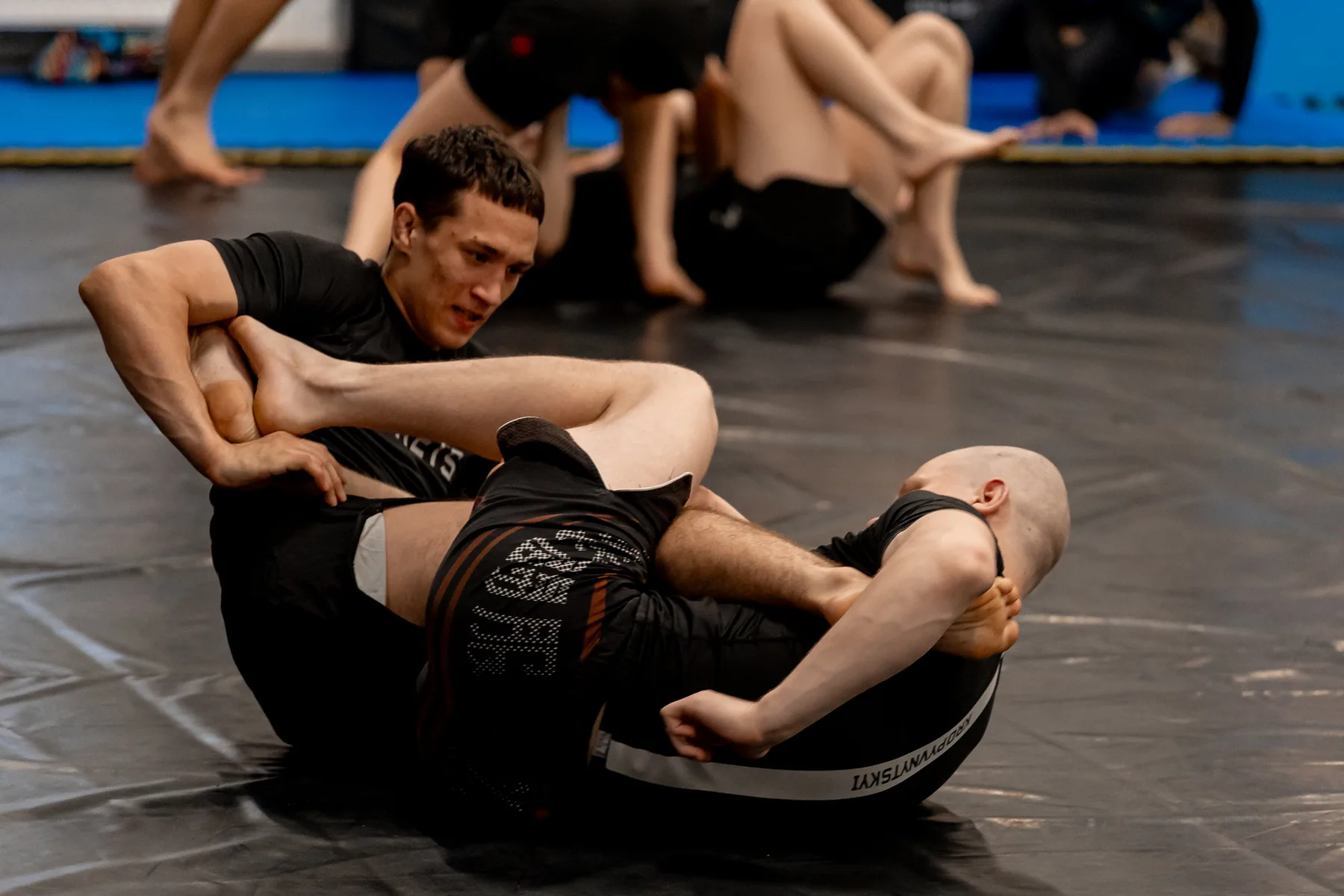
A no-gi guard-passing system starts by deciding whether to manage distance or win connection. At long range, the passer controls feet or ankles, protects stance and uses outside angles before the guard player establishes hooks. At middle range, the passer must address shins, knees and hand frames while choosing an outside lane or an inside position between the legs. At close range, chest, head, underhook or body connection can limit the hips, but only if the passer protects neck, elbows and knee alignment. The guard player’s response selects the next branch. If the knees follow an outside pass, redirect to the opposite lane or connect to the hips. If frames block direct pressure, change angle and remove the frame rather than driving harder. If the guard player sits up or wrestles up, manage head-and-hand position before continuing the pass. Clearing feet is not enough: progress through knee line, hip line and stable upper-body control while denying one realistic recovery. No-gi connection changes quickly, so the passer must know when to release a dead grip and reestablish stance. The guard player should give purposeful frames and recovery attempts rather than random resistance, allowing both athletes to identify the exact decision that changed the lane. Video review can pause the exchange at each checkpoint so athletes distinguish a cleared foot from a crossed knee line and a crossed knee line from settled control. Practice without jumping onto the partner, neck stacking, face pressure, knee twisting or uncontrolled bodyweight drops. Use progressive resistance, communicate and stop for pain or unsafe alignment. Leg-control legality and scoring vary by event and division; verify current official rules. This page provides the decision map across passing distances, distinct from a broad generic passing guide, pressure-only page or body-lock-specific tutorial.
01
What to understand
Classify the passing distance
Long, middle and close range expose different frames. Use feet-and-ankle control outside, shin-and-knee management in the middle and body connection close.
Choose outside or inside lane
An outside lane attacks around the knees; an inside lane controls space between them. The guard player’s orientation determines which is available.
Connect only after protecting posture
Head, elbows and knees must remain safe from front headlocks, underhooks and entanglements before the passer commits chest or body pressure.
Read frame and hip reactions
A following knee, stiff arm, hip turn or sit-up is information. Redirect, change level or manage head position instead of repeating one route.
Pass through three checkpoints
Clear meaningful leg control, cross the knee and hip lines, then settle shoulder or torso control against immediate recovery.
02
How to train it
Decision 1 · distance call
Coach freezes common positions. Passer identifies long, middle or close range and names the first frame that must be addressed.
Decision 2 · outside or inside
Guard player changes knee orientation. Passer chooses one lane, establishes the first control and freezes before advancing.
Decision 3 · frame redirect
Bottom inserts one hand, shin or knee frame. Top changes angle and clears it without face pressure or joint force.
Decision 4 · sit-up response
Bottom sits or wrestles up. Passer wins head-and-hand position, then continues, switches or resets without snapping the neck.
Decision 5 · pass and settle
Top scores only after crossing leg, knee and hip checkpoints and holding safe control through one honest recovery attempt.
Distance decides the first control.
Choose a lane before applying pressure.
Posture is protected before body connection.
Frames and hip turns are instructions.
Legs, knee, hip, then stable top.
03
Common mistakes
Grabbing feet without a direction
The guard player reconnects while the passer holds dead grips. Use foot control to create an angle or release it.
Entering close range with exposed posture
The neck, elbows or knees become available to attacks. Protect alignment and inside position before committing bodyweight.
Driving into a strong frame
Direct pressure strengthens the guard player’s structure. Change angle, remove the frame or switch lanes.
Calling the pass after clearing feet
Knees and hips can still recover immediately. Advance the checkpoints and establish stable upper-body control.
04
Questions athletes ask
01 · What is the best no-gi guard pass?
No single pass fits every distance and guard. Build one outside, one inside and one connected route linked by clear reactions.
02 · How is no-gi passing different from gi?
Cloth grips disappear, connections change faster and head, wrist, ankle and body position become more important. Core alignment still transfers.
03 · Should I pass standing or kneeling?
Both can work. Distance, guard structure and your protected connection determine the useful height rather than a universal preference.
04 · How should no-gi passing be trained safely?
Use progressive resistance, controlled weight, no jumping or neck stacking, and immediate stops for trapped knees, pain or unsafe alignment.
05
Sources and further reading
Training needs vary by athlete, schedule and coaching environment. Use these sources as context, then adapt with qualified support. Educational content for athletes and coaches. This guide does not diagnose injury, replace individualized coaching or override event rules. Stop if an activity causes pain, and use an appropriately qualified coach or healthcare professional for your situation.