
The direct answer
Start with the rule set, then connect stance, first contact and one reliable finish.
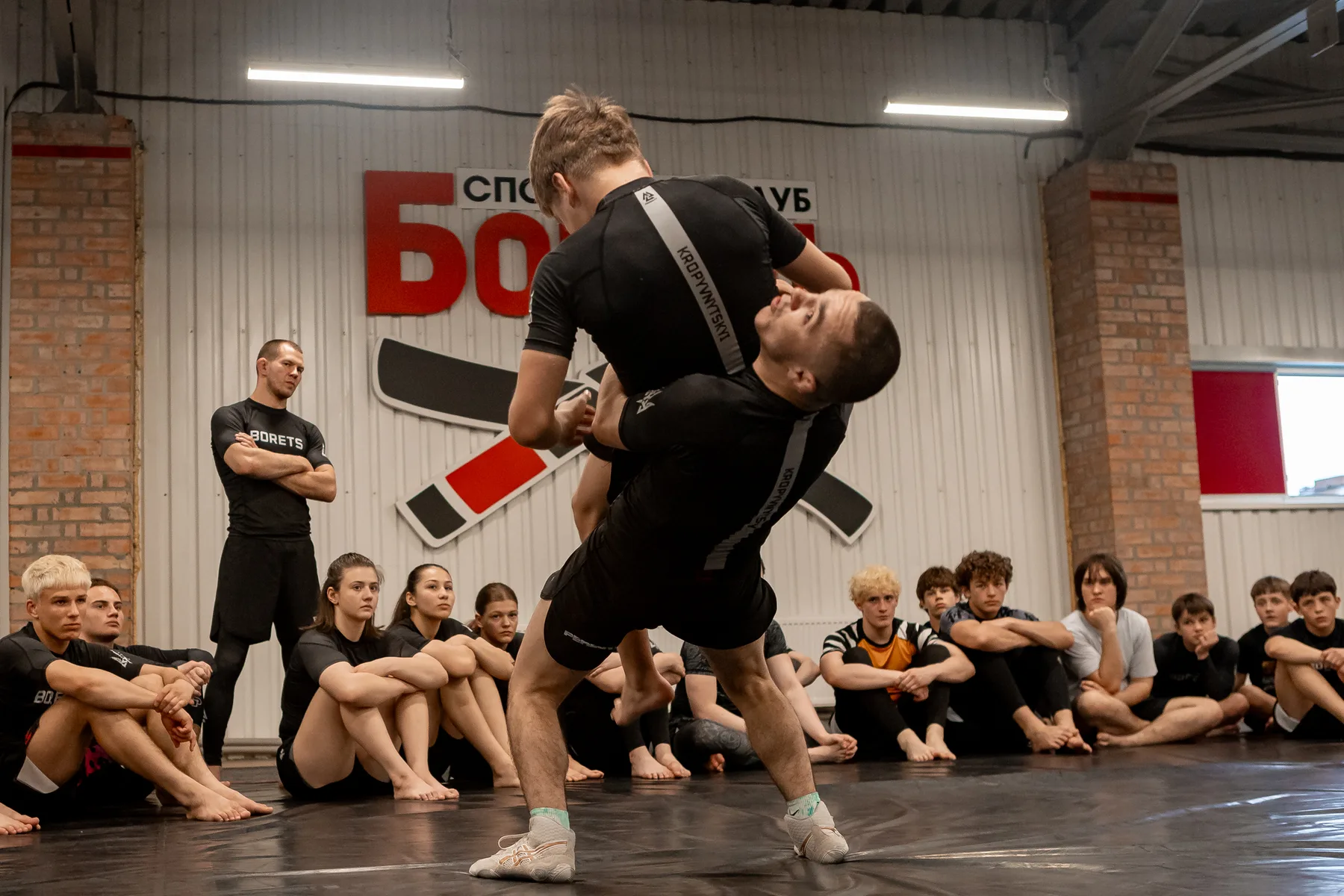
Wrestling is already a form of grappling, so “wrestling vs grappling” is not a clean category split. In common search language, wrestling usually means freestyle, Greco-Roman or American folkstyle, while “grappling” often means submission grappling: a no-strike ruleset blending BJJ, wrestling, judo, Sambo and other control or submission methods. Wrestling matches center on takedowns, exposure, pins, rides or escapes depending on style, and they do not end through joint locks or chokes. Submission grappling uses takedowns and positional control but adds submissions and may allow athletes to work from guard for much longer. Dedicated wrestling generally produces more repetitions in stance, hand fighting, chain takedowns, mat returns and immediate bottom escapes. A strong submission-grappling room generally gives more practice in passing, guard, back control, submission chains and defense around the neck and limbs. Choose wrestling when the direct objective is a wrestling season, a deep takedown base or access to a strong youth development system. Choose submission grappling when the objective is adult competition, submissions or a wider mixed ground game. For MMA, neither alone is complete: wrestling helps decide location, while submission grappling helps survive and finish when positions extend. The decisive evidence is the actual room—coach qualification, partner pool, live-round structure and schedule—not a vague label on the door.
01
What to understand
Define the rules behind “grappling”
Submission grappling can mean points-based no-gi, submission-only, ADCC-style scoring or a local hybrid. Legal heel hooks, guard pulling, overtime, slams, stalling criteria and takedown points vary. A comparison is only useful after naming the organizer and division. Ask the gym which events it prepares athletes for and whether beginner practice separates advanced submissions. Generic “grappling class” can be excellent, but its technical priorities are not self-evident.
Recognize the different bottom incentives
Wrestling normally asks the bottom athlete to escape, reverse or prevent exposure immediately. Submission grappling may let the bottom athlete build guard, entangle legs, attack arms or create a sweep. That expanded offense also creates submission danger and can concede top pressure or points. A wrestler crossing over should not abandon urgency; they should add neck, arm and leg safety. A grappler entering wrestling should add a fast stand-up branch and stop assuming guard makes bottom strategically acceptable.
Compare pace without stereotyping toughness
Short wrestling periods and scoring urgency often create dense bursts of hand fighting, shots, returns and escapes. Submission-grappling rounds may be longer and alternate explosive transitions with patient positional control. Both demand conditioning, but the energy profile differs by rules and coaching. Do not label one “harder” from a single class. Ask whether the pacing prepares athletes for the duration, rest and scoring windows of their actual event.
Use life-stage access
Youth and scholastic wrestling can provide remarkable coaching volume and competition, especially in the United States, while adult beginner wrestling remains comparatively scarce. Submission-grappling academies commonly enroll adults across wide age ranges and run year-round. In Ukraine, club and sports-school pathways may make freestyle or Greco-Roman accessible outside school. Choose the opportunity that exists now, then plan a bridge rather than waiting for a perfect hybrid program.
02
How to train it
Write the exact match brief
State starting position, duration, scoring, legal submissions, out-of-bounds behavior and win condition for the event you want. Then ask which weekly class rehearses those decisions. This converts “wrestling or grappling?” into a concrete training question and reveals when a generic open mat is not enough.
Drill takedown to submission safety
Begin from hand fighting and allow one chain takedown. As the finish develops, the defender may establish only a front headlock, guard frame or first legal submission threat. Pause, identify exposed neck or limbs, then reset. Wrestlers retain committed finishes while learning where submission rules alter head and hand placement.
Drill guard to stand-up choice
Start with the bottom athlete holding a usable guard. On a signal, the top athlete either disengages, drives forward or exposes a sweep. The bottom athlete must choose a technical stand-up, guard attack or reversal according to the named rules. This prevents guard from becoming an automatic resting place and adds wrestling urgency without erasing submission options.
Schedule crossover around one gap
A submission grappler lacking stance can add a dedicated wrestling block. A wrestler preparing for no-gi can add one positional submission session and one rules-specific round. Keep the target narrow for six weeks and measure attempts, escapes or safe decisions in live work. Random extra classes create fatigue more reliably than integration.
Wrestling is grappling; specify the comparison.
Rules turn bottom into emergency or opportunity.
Keep takedown urgency and add submission literacy.
Long rounds do not mean low intensity.
Train the event, not the label.
03
Common mistakes
Using grappling as a synonym for BJJ only
Submission grappling borrows from BJJ but also from wrestling, judo, Sambo and other systems, and individual rulesets can reward different behavior. Name the actual format instead of assuming one lineage controls every solution.
Calling guard passive by definition
A guard can create sweeps and submissions, or it can become stalled bottom position. The difference is connection, threat and rules. Evaluate what the athlete produces, not whether their back touches the mat.
Assuming crossover happens automatically
Strong wrestling habits can expose submissions; strong grappling habits can concede takedowns or pins. Transfer improves when coaches isolate the exact changed decision and let athletes practise it under bounded resistance.
04
Questions athletes ask
01 · What is the difference between wrestling and grappling?
Wrestling is a family within grappling. In everyday gym language, the comparison usually means wrestling rules without submissions versus submission grappling with chokes and joint locks. Exact scoring, ground time and legal techniques depend on the named style and event.
02 · Is wrestling better than grappling for MMA?
Wrestling often offers deeper location control, while submission grappling adds finishing and defensive layers. MMA also changes posture through strikes and fence work. The best preparation integrates both under an MMA coach instead of asking one sport to cover every phase.
03 · Can I start wrestling as an adult?
Yes, when a qualified adult program or compatible class exists. Availability is the main barrier in many U.S. cities. Look for progressive stance, falling, takedown and live-round instruction; a submission-grappling academy with a serious wrestling class can be a practical route.
04 · Should a wrestler pull guard in submission grappling?
It can be a legitimate tactical branch under some rules, but it should be learned deliberately rather than used to avoid every weak standing exchange. Understand scoring, opponent reaction and the guard offense that justifies giving up top opportunity.
05
Sources and further reading
Training needs vary by athlete, schedule and coaching environment. Use these sources as context, then adapt with qualified support. Educational content for athletes and coaches. This guide does not diagnose injury, replace individualized coaching or override event rules. Stop if an activity causes pain, and use an appropriately qualified coach or healthcare professional for your situation.